

Most businesses spend far too much time explaining what they sell and not nearly enough time understanding why people buy. They talk about features, specifications, prices, and service packages, assuming customers will recognize the value and make a decision. But the psychology of buying tells us something different. Customers aren’t simply purchasing products or services. They’re investing in outcomes, experiences, and the feelings those outcomes create.
Think about someone buying a swimming pool. The business might focus on construction materials, dimensions, filtration systems, and installation costs. But the customer may be imagining weekends with their children, relaxing after a difficult week, or creating a home where friends and family love spending time. Understanding the psychology of buying means recognizing that the product is only one part of what the customer values.
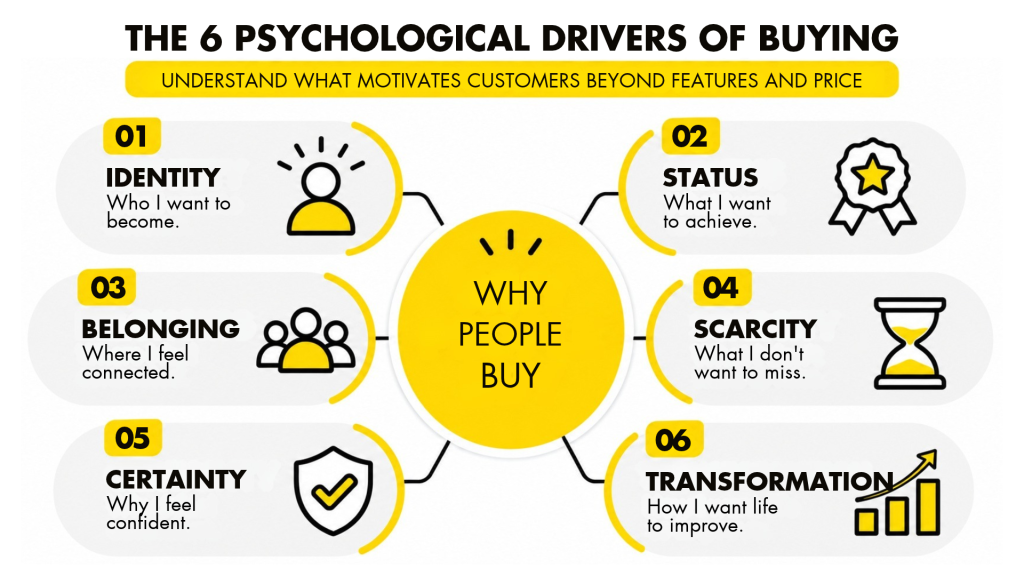
In this episode of The $100M Entrepreneur Podcast, I explore the psychology of buying and the emotional motivations that influence customer decisions. We’ll look at identity, status, belonging, scarcity, certainty, and transformation, and how businesses can use these insights to communicate value more effectively. More importantly, I’ll explain how understanding customer motivations can help you build a repeatable marketing system that attracts demand instead of constantly chasing customers.
What Is the Psychology of Buying?
The psychology of buying examines the thoughts, emotions, motivations, and social influences that shape purchasing decisions. It helps businesses understand why customers prefer certain products, trust particular brands, hesitate before buying, or willingly pay more for an experience that feels meaningful.
Customers consider practical factors such as price, quality, convenience, and performance. However, those considerations often interact with emotional needs, personal identity, perceived risk, and social expectations. Understanding the psychology of buying means looking beyond the transaction to understand what the customer hopes to achieve.
For business owners, this creates an important opportunity. Instead of competing exclusively on features and price, you can develop marketing that connects your offer with the problems customers want to solve and the outcomes they want to experience.
Why Customers Buy Outcomes Instead of Features
A product feature explains what something has or does. A benefit explains how that feature helps the customer, while an emotional outcome describes why the result matters to them.
Consider these examples:
| What the Business Sells | Practical Benefit | What the Customer May Really Want |
|---|---|---|
| Running shoes | Comfort and performance | Athletic identity, confidence, progress |
| Business coaching | Strategy and accountability | Clarity, control, freedom, growth |
| Luxury products | Quality and design | Recognition, achievement, status |
| Fitness memberships | Equipment and structured training | Health, belonging, transformation |
| Home swimming pools | Recreation and convenience | Family time, relaxation, lifestyle |
| Financial planning | Financial organization and guidance | Security, certainty, peace of mind |
These motivations aren’t universal. Different customers can purchase the same product for completely different reasons.
That’s why the psychology of buying begins with understanding your actual customers rather than assuming everyone wants the same emotional outcome.
1. Identity: Sell Who the Customer Wants to Become
One of the most important principles in the psychology of buying is that purchases can reflect a person’s identity.
People often choose products and brands that reinforce how they see themselves or how they want to be perceived. Sometimes that identity is already established, while other times the purchase represents an aspiration.
A person buying running shoes may be motivated by comfort and performance, but they may also be taking a step toward seeing themselves as a committed athlete. The product becomes part of a larger personal story.
Why Identity-Based Marketing Works
Consider brands such as Apple and Harley-Davidson.
For some Apple customers, the brand represents creativity, innovation, and a particular approach to technology. For some Harley-Davidson riders, the appeal extends beyond the motorcycle to ideas of freedom, independence, and shared identity.
The psychology of buying helps explain why these associations can matter. Customers may evaluate functional performance while also considering whether a product fits their values and aspirations.
Businesses can use this understanding by communicating the transformation their products support rather than relying entirely on technical descriptions.
Ask the Identity Question
When developing your marketing message, ask:
Who does this product or service help the customer become?
For a business coaching company, the answer might involve helping an overwhelmed owner become a more confident leader.
For a fitness business, it might involve helping someone become healthier, stronger, or more consistent.
For an educational service, it might involve helping a customer develop skills and confidence.
An effective application of the psychology of buying connects the offer with a meaningful aspiration without promising unrealistic results.
Turn Identity Into Marketing Messages
Compare these two approaches.
Feature-focused message: “Our business coaching program includes weekly meetings, performance reviews, and strategic planning.”
Identity-focused message: “Build the leadership skills and business systems to become the owner who leads growth instead of managing every daily problem.”
The second message connects the service with a professional identity the customer may want to develop.
That doesn’t mean the practical details should disappear. Customers still need to understand what they’re purchasing.
The psychology of buying works best when emotional relevance and practical value reinforce each other.
2. Status: Understand the Desire for Recognition and Achievement
Status is another important influence in the psychology of buying.
When people hear the word status, they often think about expensive cars, luxury watches, and designer clothing. But status is much broader than wealth or luxury.
It can involve professional recognition, personal achievement, social standing, expertise, independence, or progress toward a meaningful goal.
Customers may choose products partly because those purchases communicate something about their accomplishments or aspirations.
Status Isn’t Always About Money
Consider an entrepreneur investing in a leadership development program.
The practical objective may be improving management skills. But the customer may also want to become recognized as a capable leader who can guide a growing organization.
Someone purchasing professional equipment might value its performance while also appreciating what it represents about their commitment to their work.
The psychology of buying reminds us that customers can attach personal meaning to purchases that appear purely functional.
Understand What Achievement Means to Your Customer
Different audiences define success differently.
For one customer, status might mean owning a premium product.
For another, it might mean having the freedom to spend more time with family.
For a business owner, it might mean developing a management team capable of operating independently.
Your marketing should reflect the aspirations of your actual customers rather than assuming everyone wants prestige or public recognition.
Position Your Offer Around Meaningful Progress
Instead of emphasizing exclusivity for its own sake, show how your product supports a genuine achievement.
A professional training company might communicate the skills participants can develop.
A business coach might explain how better systems can help owners delegate more effectively.
A premium service provider might demonstrate the quality, attention, or convenience customers receive.
Understanding the psychology of buying allows businesses to connect achievement with authentic value rather than manufacturing an appearance of status.
Avoid Making Customers Feel Inadequate
Status-based marketing becomes problematic when it relies on humiliation, insecurity, or unrealistic comparisons.
You don’t need to convince customers they’re unsuccessful to make your offer appealing.
Instead, recognize their ambitions and demonstrate how your business can support meaningful progress.
The psychology of buying should help you understand customers, not exploit their insecurities.
3. Belonging: Turn Customers Into a Community
Human beings value connection.
We want to feel understood, accepted, and connected to people who share our interests or experiences. This desire for belonging can influence the brands we choose and the communities we join.
In the psychology of buying, belonging helps explain why some customer relationships extend far beyond a single transaction.
People may become attached not only to a product but also to the shared experiences and relationships surrounding it.
The Difference Between a Customer Base and a Community
A customer base consists of people who purchase from your business.
A community creates opportunities for those customers to connect around shared interests, goals, or experiences.
Consider the communities that have developed around CrossFit or Tesla ownership.
Some participants enjoy discussing their experiences, sharing progress, exchanging advice, and connecting with others who have similar interests.
The psychology of buying helps explain why these social connections can strengthen a customer’s relationship with a brand.
However, community membership doesn’t automatically guarantee loyalty or referrals. The underlying product and customer experience still need to deliver value.
Build Relationships Beyond the Transaction
Businesses can encourage belonging by creating meaningful opportunities for customer interaction.
Examples include:
- Customer education groups
- Member events and workshops
- Professional networking communities
- Peer learning sessions
- Customer recognition programs
- Shared challenges and milestones
- Online discussions around relevant interests
The goal isn’t simply to create another social media group.
It’s to provide an environment where customers gain value from connecting with your business and one another.
An understanding of the psychology of buying helps you design these experiences around genuine customer needs.
Make Customers Feel Recognized
Belonging often begins with simple actions.
Listen to customers, acknowledge their progress, invite meaningful feedback, and create opportunities for participation.
For example, a business coaching company might bring owners together to discuss leadership challenges and exchange practical ideas.
The value extends beyond the coaching service because participants can learn from people facing similar situations.
The psychology of buying shows why connection can become part of the overall customer experience.
Community Can Support Long-Term Demand
When customers have positive experiences and meaningful relationships with a brand, they may be more willing to continue participating, share recommendations, or purchase additional services.
That can support customer retention and referrals.
But community-building should remain focused on delivering value rather than treating relationships as another promotional channel.
The strongest communities give customers a reason to participate even when nobody is trying to sell them something.
4. Scarcity: Create Urgency Without Manipulation
Scarcity is one of the more recognizable principles in the psychology of buying.
When something is genuinely limited, customers may place greater value on the opportunity or feel more motivated to make a decision.
This can happen with limited event capacity, seasonal availability, enrollment deadlines, or products that are difficult to obtain.
However, scarcity is only useful when it reflects a real constraint.
Why Limited Availability Can Influence Decisions
Imagine a business owner considering a workshop with a limited number of places.
If the workshop is relevant and the available spaces are genuinely restricted, that information may encourage the owner to decide sooner.
The psychology of buying helps explain this response because people may be motivated to avoid missing an opportunity they value.
But scarcity doesn’t create value on its own.
A limited offer still needs to solve a meaningful problem or provide a desirable experience.
Use Genuine Scarcity in Your Marketing
Examples of legitimate scarcity include:
- Limited seats in an in-person workshop
- Enrollment periods with real closing dates
- Services restricted by available staff capacity
- Products with genuinely limited inventory
- Invitation-only programs with defined eligibility
- Waiting lists for services with constrained availability
These situations can help customers understand why they may need to make a timely decision.
The psychology of buying can guide how you communicate these constraints clearly and responsibly.
Avoid Artificial Urgency
Fake countdown timers, invented inventory shortages, and deadlines that repeatedly reset can damage customer trust.
Even if these tactics produce short-term responses, they may create negative experiences and weaken long-term relationships.
A business that depends on manipulation risks undermining the credibility it has worked to establish.
The psychology of buying should help you communicate genuine opportunities, not manufacture pressure.
Combine Scarcity With Clear Value
Scarcity is most useful when customers already understand why the offer matters.
Explain what the customer receives, who the offer is designed for, and why availability is limited.
Then allow people to make informed decisions.
Strong marketing doesn’t need to pressure everyone into buying immediately.
It needs to help the right customers recognize relevant opportunities.
5. Certainty: Reduce the Fear of Making the Wrong Decision
Certainty is one of the most important influences in the psychology of buying, particularly when customers are considering expensive or complicated purchases.
Buying involves uncertainty.
Customers may wonder whether the product will work, whether the company is reliable, whether the service will deliver value, or whether they’ll regret their decision.
These concerns can delay purchases even when customers are interested.
Why Perceived Risk Matters
Imagine a business owner considering a significant investment in consulting services.
They may understand the potential benefits but still have questions about the process, expected outcomes, implementation requirements, and financial commitment.
If those questions remain unanswered, the customer may hesitate.
The psychology of buying reminds us that reducing uncertainty can be just as important as communicating benefits.
Customers need enough information to evaluate the decision confidently.
Build Trust Through Evidence
Useful trust-building resources include:
| Trust Asset | How It Supports Customer Confidence |
|---|---|
| Customer Reviews | Provides feedback from previous customers |
| Testimonials | Shares relevant customer experiences |
| Case Studies | Explains problems, processes, and outcomes |
| Guarantees | Clarifies specific commitments and protections |
| Demonstrations | Shows how a product or service works |
| Transparent Pricing | Helps customers understand financial commitments |
| Clear Processes | Explains what customers should expect |
| Professional Recognition | Provides relevant evidence of qualifications or credibility |
These resources can help address different types of customer concerns.
However, they must be accurate and relevant.
A guarantee should clearly explain its terms, and a case study should accurately represent the customer’s experience.
Make the Buying Process Easier to Understand
Confusion creates unnecessary friction.
If customers can’t understand your offer, pricing, process, or next steps, they may decide not to proceed.
Explain what happens after someone makes an inquiry.
Describe the service process, expected responsibilities, and available support.
The psychology of buying helps businesses recognize that clarity can contribute to confidence.
Use Proof Throughout the Customer Journey
Don’t wait until the final sales conversation to demonstrate credibility.
Include relevant proof in educational content, service pages, follow-up emails, webinars, and sales presentations.
A customer researching your business should be able to find useful answers before speaking with a salesperson.
This approach can make conversations more productive because prospects arrive with a better understanding of the offer.
The psychology of buying emphasizes the importance of helping customers feel informed rather than pressured.
Certainty Doesn’t Mean Guaranteeing Results
No business can eliminate every risk.
Avoid promising outcomes you can’t reasonably support.
Instead, communicate honestly about what your product or service provides, how the process works, and what customers can expect.
Trust grows when businesses are transparent about both their capabilities and limitations.
6. Pain and Dreams: Sell the Transformation, Not the Transaction
The final principle in the psychology of buying brings the other motivations together.
Customers often make purchasing decisions because they want to move away from a problem or toward a better outcome.
Sometimes the immediate motivation is frustration, uncertainty, inconvenience, or dissatisfaction.
Other times it’s the desire for growth, freedom, confidence, recognition, or a different lifestyle.
Strong marketing understands both sides.
Identify the Problem Customers Want to Escape
Every meaningful offer should address a recognizable customer need.
A business owner might feel overwhelmed because every decision requires their approval.
A parent might struggle to find time for family activities.
A professional might feel frustrated by a lack of career progress.
The psychology of buying helps businesses understand the emotional consequences of these challenges.
But effective messaging shouldn’t exaggerate pain or make customers feel worse about themselves.
It should demonstrate understanding and explain how the business can help.
Show the Future Customers Want to Create
Customers also need a reason to believe improvement is possible.
For the overwhelmed business owner, the desired future might involve a capable management team and more time for strategic decisions.
For the parent considering a swimming pool, it might involve creating more opportunities for family activities.
For someone pursuing professional development, it might involve gaining skills and confidence.
The psychology of buying connects these aspirations with the practical value of the offer.
Sell the Transformation, Not Just the Product
Consider the swimming pool example again.
The business sells a physical product with specific dimensions, materials, and installation requirements.
But customers may be purchasing an opportunity to enjoy more time with family, relax at home, and create meaningful experiences.
The strongest message connects the functional product with the outcome the customer values.
This doesn’t mean ignoring practical details.
Customers still need accurate information about cost, installation, maintenance, and performance.
The psychology of buying works when the emotional promise is supported by a credible product or service.
Connect Pain, Solution, and Possibility
A useful marketing framework is:
Current Problem → Practical Solution → Desired Outcome
For example:
Current Problem: A business owner spends too much time solving daily operational issues.
Practical Solution: Develop management systems, clearer responsibilities, and leadership accountability.
Desired Outcome: Create a business that operates more consistently without requiring the owner’s involvement in every decision.
This approach makes the transformation easier to understand.
It also helps customers connect the service with a realistic improvement in their circumstances.
Use Small Commitments to Build Confidence
Not every prospect is ready to make a significant purchase immediately.
Some need time to understand the problem, evaluate their options, and become comfortable with the business.
Smaller steps can help.
A customer might begin by reading an article, attending a webinar, completing an assessment, requesting a demonstration, or booking an introductory consultation.
Each interaction should provide genuine value and help the customer decide whether the next step is appropriate.
The psychology of buying supports creating a buying journey that develops understanding and confidence over time.
How to Apply the Psychology of Buying to Your Marketing System
Understanding customer motivations is useful, but applying those insights consistently is what creates business value.
Your marketing shouldn’t depend on occasionally writing an emotional advertisement or creating a compelling sales presentation.
The psychology of buying should influence how your business communicates across the entire customer journey.
Start With Customer Research
Before changing your marketing messages, talk to your customers.
Ask what prompted them to look for a solution, what alternatives they considered, and what ultimately influenced their decision.
Explore what they hoped to achieve and what concerns they had before purchasing.
This research helps you understand the psychology of buying from actual customer experiences rather than assumptions.
Connect Emotional Motivations to Each Marketing Stage
| Marketing Stage | Psychological Focus | Practical Application |
|---|---|---|
| Attention | Identity and aspiration | Content that reflects customer goals |
| Trust | Certainty and credibility | Reviews, case studies, demonstrations |
| Lead Capture | Relevance and perceived value | Useful guides, assessments, webinars |
| Nurture | Belonging and confidence | Educational content, community, customer stories |
| Conversion | Transformation and risk reduction | Clear offers, realistic outcomes, transparent processes |
| Retention | Progress and belonging | Customer support, recognition, community experiences |
This framework helps turn the psychology of buying into a repeatable marketing approach.
Rather than relying on individual campaigns, you can build consistent messaging that reflects what customers value at each stage.
Make Your Messaging Consistent
Your advertisements, website, emails, webinars, and sales conversations should communicate a recognizable promise.
If your business positions itself around helping entrepreneurs gain freedom, that idea should be supported by the services you provide and the customer experiences you deliver.
Consistency makes the message easier to understand.
The psychology of buying becomes more effective when the business’s promise and actual performance reinforce one another.
Test What Resonates With Customers
Different audiences respond to different motivations.
Some customers prioritize certainty and reliability, while others may place greater value on achievement, convenience, or belonging.
Test relevant messaging approaches through advertisements, landing pages, emails, and sales conversations.
Track meaningful outcomes such as qualified inquiries, conversion rates, customer acquisition costs, and customer retention.
The psychology of buying should guide informed experimentation rather than replace measurement.
The Psychology of Buying Scorecard
Use this scorecard to evaluate how effectively your marketing connects with customer motivations.
| Psychological Driver | Question to Ask |
|---|---|
| Identity | Does our message reflect who customers want to become? |
| Status | Do we understand what achievement means to our audience? |
| Belonging | Do customers have meaningful opportunities to connect? |
| Scarcity | Do we communicate genuine limitations honestly? |
| Certainty | Do we provide credible evidence and clear expectations? |
| Pain | Do we understand the problems customers want to solve? |
| Dreams | Do we communicate a desirable and realistic future? |
| Transformation | Do we connect our offer with meaningful customer outcomes? |
Rate each area from 1 to 10 based on your current marketing.
Identify where your messaging may be overly focused on features or where customers may lack enough information to make confident decisions.
The purpose of this psychology of buying scorecard isn’t to maximize every emotional trigger.
It’s to identify the motivations that genuinely matter to your audience and communicate them more effectively.
Your 30-Day Customer Psychology Challenge
You don’t need to rebuild your entire marketing strategy to begin applying these principles.
Start with customer research, improve your messaging, and test the changes.
Week 1: Discover Why Customers Really Buy
Interview a selection of current or recent customers.
Ask what problem led them to seek help, what they hoped would change, and why they chose your business.
Look for recurring themes involving identity, certainty, progress, belonging, or other relevant motivations.
Use these insights to develop a clearer understanding of the psychology of buying within your customer base.
Week 2: Rewrite Your Marketing Around Outcomes
Review your website, advertisements, service descriptions, and sales materials.
Identify messages that focus exclusively on features.
Rewrite selected sections to connect practical benefits with customer outcomes.
For example, instead of promoting only the number of coaching sessions included in a program, explain the business challenges those sessions are designed to address.
Use the psychology of buying to improve relevance without exaggerating the results customers can expect.
Week 3: Strengthen Trust and Customer Connection
Review your testimonials, case studies, customer support processes, and community activities.
Make credible proof easier for prospects to discover.
Identify opportunities to answer common customer concerns and explain your services more clearly.
Consider whether customers would benefit from educational events, professional discussions, or other opportunities to connect.
The psychology of buying can help you strengthen relationships beyond the initial purchase.
Week 4: Test, Measure, and Improve
Choose one or two marketing messages to test.
Compare an existing feature-focused approach with messaging that communicates a relevant customer outcome.
Track qualified inquiries, conversion rates, and other meaningful performance indicators.
Review the results before making broader changes.
Applying the psychology of buying is an ongoing process of understanding customers, improving communication, and learning what genuinely influences decisions.
Stop Selling Features. Start Communicating Value.
Most businesses don’t struggle because their products lack features.
They struggle because customers don’t always understand why those features matter.
A swimming pool isn’t only about construction materials. Business coaching isn’t only about meetings and frameworks. Fitness isn’t only about equipment and training sessions.
Customers are looking for outcomes that improve their lives, businesses, or sense of progress.
That’s why understanding the psychology of buying matters.
Identity helps explain who customers want to become. Status reflects achievement and recognition. Belonging creates meaningful connections, while genuine scarcity can influence timing. Certainty reduces uncertainty, and transformation connects today’s challenges with tomorrow’s possibilities.
These motivations don’t replace product quality, fair pricing, or excellent customer service.
They help businesses communicate the value those fundamentals create.
When you understand the psychology of buying, you can build marketing that speaks to genuine customer needs rather than relying entirely on features, discounts, and promotional claims.
Customers don’t simply buy what you sell. They buy what your product or service helps them achieve, experience, or become.
Your job as a business owner is to understand that desired outcome, communicate it clearly, and build a business capable of delivering it.
In this episode of The $100M Entrepreneur Podcast, I explore the psychology of buying and the emotional motivations that influence customer decisions.
We discuss why identity, status, belonging, scarcity, certainty, and transformation matter in marketing, and how businesses can use these insights to communicate more effectively with potential customers.
I also explain why customers often value outcomes more than features, how credible proof can reduce purchasing uncertainty, and why strong marketing connects the problems customers want to escape with the future they want to create.
Listen to or watch the full episode of The $100M Entrepreneur Podcast to discover how understanding the psychology of buying can help you create stronger customer connections, communicate meaningful value, and build demand for your business.

- Why Your Sales Process is Failing (And How to Fix It) - November 18, 2026
- Train Them Or Lose Them - November 17, 2026
- The First 90 Days: How to Turn New Hires Into High-Performing Employees - November 16, 2026