

You can have thousands of followers, hundreds of likes, and videos that attract impressive numbers of views, yet still struggle to generate enough revenue to grow your business. I’ve seen business owners become so focused on social media performance that they forget what marketing is supposed to accomplish. The goal isn’t to become popular on the internet. The goal is to attract customers, generate sales, and build a profitable business. That’s why profitable social media marketing requires a completely different approach from simply posting content and hoping something works.
Social media platforms have made it easier than ever to reach people, but attention alone doesn’t pay the bills. A post that receives thousands of views might produce no qualified inquiries, while a piece of educational content reaching a much smaller audience could lead to a valuable customer relationship. The difference comes down to strategy. Profitable social media marketing connects content with customer needs, builds credibility, and gives interested prospects a clear path toward doing business with you.
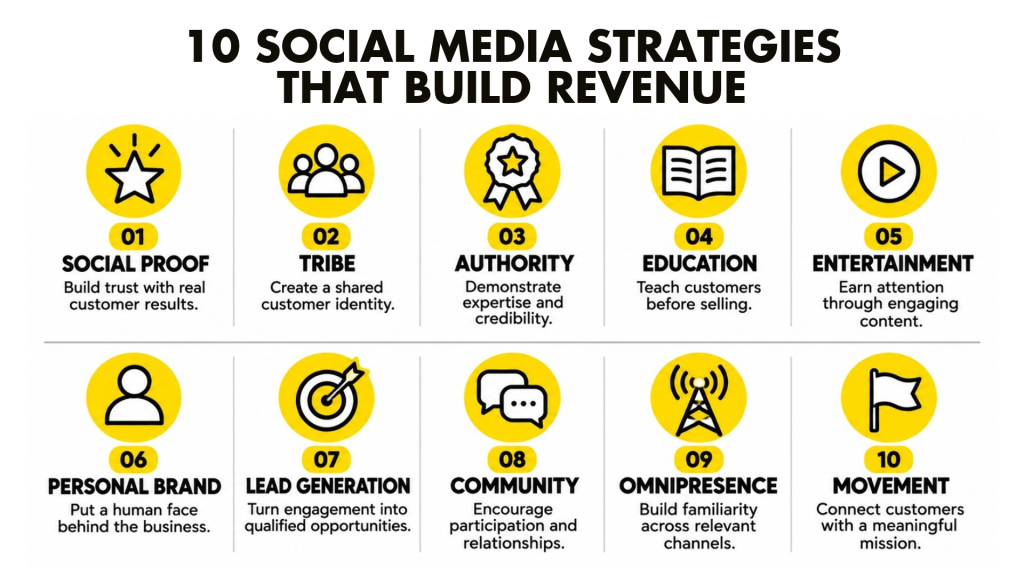
In this episode of The $100M Entrepreneur Podcast, I break down ten approaches to profitable social media marketing that business owners can use to create meaningful results. We’ll explore social proof, tribe building, authority, education, entertainment, personal branding, lead generation, community, omnipresence, and movement marketing. More importantly, I’ll explain how to choose the right strategies for your business, make them repeatable, and measure whether they’re contributing to growth.
What Is Profitable Social Media Marketing?
Profitable social media marketing is the strategic use of social platforms to attract relevant audiences, establish trust, generate qualified opportunities, and support revenue and profitability.
Unlike an approach focused primarily on followers, impressions, or engagement, profitable social media marketing connects social media activity with measurable business objectives.
Those objectives might include generating inquiries, booking appointments, acquiring customers, increasing repeat purchases, strengthening retention, or encouraging referrals.
The important distinction is that social media supports the business model rather than becoming an activity disconnected from commercial performance.
Why Followers and Likes Aren’t Enough
Followers, likes, shares, and views can provide useful information about audience reach and content engagement.
However, they don’t automatically demonstrate that a marketing strategy is profitable.
Imagine a consulting company publishing a video that receives 100,000 views but generates no qualified inquiries.
Now imagine the same company publishing a detailed educational video that receives 2,000 views and produces five qualified sales conversations.
The second video may contribute more directly to business growth, depending on the value and profitability of the resulting customers.
Profitable social media marketing evaluates both audience engagement and the commercial outcomes that follow.
The Customer Journey Behind Social Media Profitability
A useful way to understand profitable social media marketing is to look at the customer journey:
Attention → Trust → Leads → Sales → Retention → Referrals
Attention helps people discover your business. Trust gives them reasons to consider your offer, while lead generation creates opportunities for further conversations.
Sales convert qualified opportunities into customers, and a strong customer experience supports retention and referrals.
Profitable social media marketing works best when your content contributes to one or more stages of this journey.
The 10 Strategies for Profitable Social Media Marketing
Not every business needs to use all ten strategies.
Some companies benefit most from demonstrating expertise, while others succeed by developing communities, creating entertaining content, or building recognizable personal brands.
The objective is to understand the available approaches and select the ones that fit your customers, products, and business goals.
1. Social Proof Marketing: Let Customer Results Build Trust
One of the most effective foundations of profitable social media marketing is social proof.
Customers want to know whether your business can deliver what it promises.
You can tell people you’re excellent at what you do, but independent evidence often provides stronger support for those claims.
Reviews, testimonials, case studies, customer stories, and documented results can help prospects evaluate your credibility.
Why Social Proof Influences Buying Decisions
Imagine you’re choosing between two service providers.
The first company repeatedly posts promotional messages claiming to deliver outstanding results.
The second shares detailed customer experiences, explains the problems it has helped solve, and provides credible evidence of its work.
The second business gives you more information to evaluate.
Profitable social media marketing uses authentic customer proof to make the value of a product or service easier to understand.
Turn Customer Experiences Into Content
Social proof content might include:
- Customer testimonials describing specific experiences
- Case studies explaining a challenge and the solution
- Reviews shared with appropriate attribution
- Customer interviews
- Before-and-after examples with accurate context
- Stories showing how customers use a product or service
For a business coaching company, a case study might explain how a client introduced clearer management responsibilities and improved operational consistency.
The objective isn’t to exaggerate results or imply every customer will achieve the same outcome.
It’s to demonstrate genuine experiences that help potential buyers understand the service.
Make Social Proof a Repeatable Process
Don’t wait until you urgently need testimonials.
Create a consistent process for requesting honest feedback, obtaining permission to share customer stories, and organizing approved materials.
Your team can then incorporate relevant proof into educational posts, service explanations, and lead generation content.
Profitable social media marketing becomes more effective when credibility is supported by a growing library of authentic customer experiences.
2. Tribe Marketing: Build a Shared Customer Identity
Tribe marketing focuses on creating a sense of shared identity among customers.
People often connect with brands that reflect their values, aspirations, interests, or beliefs.
When customers recognize something about themselves in a brand, their relationship may extend beyond the product itself.
This makes tribe building a useful approach to profitable social media marketing, particularly for businesses serving audiences with strong shared interests.
The Difference Between Followers and a Tribe
A follower may enjoy your content without feeling a meaningful connection to your business.
A tribe develops when people identify with what the brand represents.
For example, a fitness brand might attract customers who see themselves as committed to personal progress.
A business coaching company might connect entrepreneurs who believe in building businesses that create freedom rather than constant owner dependency.
The shared identity provides a reason for customers to pay attention beyond individual promotions.
Create a Recognizable Brand Identity
Ask yourself what your ideal customers believe, value, and want to achieve.
What language do they use when describing their challenges?
What aspirations do they share?
What does being part of your customer base represent to them?
Profitable social media marketing can use these insights to develop messages that feel relevant and recognizable.
Reinforce Shared Values Through Content
Tribe marketing might include customer stories, shared milestones, common terminology, and content that reflects the audience’s experiences.
The important thing is authenticity.
Customers should recognize a genuine connection between the brand’s message and the experience it delivers.
Profitable social media marketing builds stronger relationships when shared identity is supported by consistent business behavior.
3. Authority Marketing: Become the Expert Customers Trust
Authority marketing is particularly relevant for coaches, consultants, professional service providers, and businesses selling expertise.
When customers face complicated decisions, they often look for someone who can explain the problem and demonstrate relevant knowledge.
Authority content helps them understand how your business thinks and why your expertise may be useful.
For many service-based businesses, authority is a central component of profitable social media marketing.
Demonstrate Expertise Instead of Claiming It
Anyone can describe themselves as an expert.
But expertise becomes more credible when people can see how you approach real problems.
Share useful frameworks, explain common mistakes, discuss industry developments, and provide informed perspectives.
A business coach might explain why a growing company struggles with delegation.
An accountant might discuss common cash flow management mistakes.
A consultant might outline the steps involved in improving operational efficiency.
Profitable social media marketing uses this type of content to help customers evaluate professional knowledge.
Develop a Clear Point of View
Authority doesn’t require being controversial.
It requires having informed perspectives that contribute something useful to the conversation.
You might challenge a common misconception, explain why a popular approach doesn’t work in every situation, or introduce a practical framework.
Your content should reflect genuine expertise rather than opinions created simply to attract attention.
Profitable social media marketing becomes more valuable when people associate your business with useful, credible insights.
Build a Consistent Authority Library
Publish educational videos, articles, interviews, podcasts, and practical explanations around your core areas of expertise.
Connect these resources so customers can explore related topics.
Over time, your content library can demonstrate the depth and consistency of your knowledge.
This creates an asset that supports profitable social media marketing beyond individual posts.
4. Educational Marketing: Teach Before You Sell
Educational marketing helps potential customers understand their problems, evaluate solutions, and make informed decisions.
Instead of leading every conversation with a sales pitch, the business provides useful information.
This approach is especially valuable when customers need time to understand a product or service before purchasing.
Profitable social media marketing often depends on education because informed prospects can enter sales conversations with greater clarity.
Answer the Questions Customers Are Already Asking
Start with the problems your ideal customers want to solve.
What are they confused about?
What mistakes do they commonly make?
What information would help them choose an appropriate solution?
For example, a business coach might create content about improving profitability, building management systems, or increasing sales conversion.
These topics connect directly with challenges business owners already experience.
Use Different Educational Formats
Educational content can include:
- How-to videos
- Practical tutorials
- Step-by-step guides
- Frequently asked questions
- Webinars
- Short educational clips
- Podcast discussions
- Buying guides
- Industry explainers
The format matters less than the usefulness of the information.
Profitable social media marketing should make valuable knowledge accessible in ways that suit the audience.
Education Builds Trust Before the Sales Conversation
A customer who has learned from your content may already understand your approach and the problems your service addresses.
That doesn’t guarantee a sale, but it can make the conversation more productive.
Instead of spending the entire meeting explaining basic concepts, you may be able to focus on the customer’s specific circumstances.
Profitable social media marketing uses education to support customer understanding rather than pressure people into purchasing before they’re ready.
5. Entertainment Marketing: Earn Attention Through Emotion
Not every social media post needs to be educational.
Sometimes the most effective way to introduce a brand is through entertaining content that captures attention.
Stories, humor, relatable experiences, and creative presentation can encourage people to stop scrolling and engage.
Entertainment can therefore support profitable social media marketing, particularly when the content attracts the right audience.
Why Entertainment Works at the Top of the Funnel
People don’t always open social media looking for products or services.
They may be looking for information, connection, inspiration, or entertainment.
Content that reflects those interests can introduce your business to people who might not otherwise encounter it.
For example, a business coach could create a humorous video about common leadership mistakes.
The content might entertain viewers while introducing a recognizable business challenge.
Connect Entertainment to Your Business
A funny video isn’t necessarily effective marketing.
If the content attracts people who have no interest in your industry, it may generate engagement without commercial value.
Profitable social media marketing uses entertainment that remains connected to the audience’s interests, problems, or aspirations.
The objective isn’t simply to make people laugh.
It’s to earn relevant attention and create opportunities for a deeper relationship.
Balance Entertainment With Substance
Entertainment can introduce your business, but other content may be needed to establish credibility and encourage action.
Combine engaging stories with educational resources, customer proof, and relevant next steps.
That way, attention becomes part of a broader marketing process.
Profitable social media marketing treats entertainment as a strategic tool rather than an end in itself.
6. Personal Brand Marketing: Put a Human Face Behind the Business
People often find it easier to connect with individuals than with organizations that have no recognizable personality.
A founder or business leader can communicate expertise, experiences, values, and perspectives in a way that feels more personal than generic corporate messaging.
For expertise-driven businesses, personal branding can become a useful part of profitable social media marketing.
Why Founder-Led Content Can Be Effective
A founder understands the business’s origins, challenges, customers, and vision.
Sharing those experiences can help audiences understand the thinking behind the company.
A business owner might explain a lesson learned from a difficult decision, discuss an industry challenge, or share an approach to solving a common customer problem.
These insights can make the business more recognizable and relatable.
Build Recognition Through Consistency
Choose a few topics that reflect your expertise and the problems your customers face.
Develop a consistent approach to communicating those ideas.
That might involve short videos, professional commentary, podcast appearances, or educational posts.
Profitable social media marketing benefits when people understand what the founder stands for and how that expertise connects with the business.
Avoid Creating Another Owner-Dependent System
There’s an important distinction between founder-led marketing and founder-dependent marketing.
A founder can provide ideas, expertise, and direction without personally producing every piece of content.
The team can help organize interviews, edit videos, repurpose material, and manage distribution.
Profitable social media marketing should use the founder’s expertise while developing processes that can operate without constant personal involvement.
7. Lead Generation Marketing: Turn Engagement Into Opportunities
Lead generation connects social media activity with measurable business opportunities.
A person might enjoy your content, follow your account, or watch several videos without being ready to purchase.
But when they want to learn more, your business should provide a clear next step.
This is where profitable social media marketing moves beyond engagement toward customer acquisition.
Give Interested Prospects a Reason to Raise Their Hand
Lead generation works best when the offer is relevant to the content that attracted the prospect.
For example, someone watching a video about improving business profitability might be interested in a financial performance assessment.
A person reading about leadership development might want to attend a related webinar.
Useful lead generation offers include:
| Lead Generation Tool | Potential Customer Value |
|---|---|
| Webinar | Learn about a specific challenge |
| Downloadable Guide | Access practical information |
| Assessment | Identify improvement opportunities |
| Quiz | Explore a relevant need |
| Consultation | Discuss a particular problem |
| Free Tool | Complete a useful task |
| Event | Learn and connect with relevant people |
An effective offer creates a natural transition from interest to deeper engagement.
Don’t Ask for the Sale Too Early
Someone who has just discovered your business may not be ready for a sales conversation.
They may need to understand your expertise, compare options, or learn more about their problem.
Profitable social media marketing respects that process.
Provide useful information first, then offer an appropriate next step when the prospect demonstrates interest.
Connect Leads to a Follow-Up Process
Capturing contact details is only the beginning.
Your business needs a process for delivering promised resources, answering questions, and following up appropriately.
That might involve email nurturing, appointment scheduling, or a customer relationship management system.
Profitable social media marketing becomes more measurable when inquiries are recorded and connected to eventual sales outcomes.
8. Community Marketing: Turn Customers Into Participants
Community marketing creates opportunities for customers and prospects to interact with the business and one another.
It differs from tribe marketing in an important way.
Tribe marketing focuses on shared identity, while community marketing focuses on ongoing interaction and participation.
Both can contribute to profitable social media marketing, but they serve different purposes.
Build Experiences That Encourage Participation
A community should provide value beyond promotional messages.
Members might exchange advice, discuss common challenges, attend events, or share progress toward goals.
For example, a business coaching company might facilitate conversations among entrepreneurs dealing with similar leadership challenges.
These interactions can help participants learn from one another.
Give People a Reason to Return
Successful communities require ongoing attention.
Ask useful questions, encourage relevant discussions, recognize contributions, and provide opportunities for members to participate.
Avoid turning every conversation into a sales pitch.
Profitable social media marketing can benefit from community participation when customers feel the experience is worthwhile.
Connect Community to Retention and Referrals
A positive community experience can strengthen relationships and encourage customers to remain engaged.
Members may also share recommendations when they believe others could benefit from the business.
However, community activity should be evaluated alongside customer satisfaction and business outcomes.
Profitable social media marketing doesn’t assume that a large community automatically creates revenue.
It focuses on whether the community provides meaningful value.
9. Omnipresence Marketing: Build Familiarity Across Relevant Channels
Omnipresence marketing is about maintaining a recognizable presence across the channels your audience uses.
A potential customer might encounter your business through LinkedIn, watch a YouTube video, listen to a podcast, read an article, and later subscribe to your newsletter.
Each relevant interaction creates another opportunity to understand your expertise.
This makes omnipresence an important approach to profitable social media marketing when executed consistently.
Create Once and Distribute Strategically
Producing completely new content for every platform can consume enormous amounts of time.
Instead, start with a substantial piece of useful content and adapt it for different channels.
For example, one podcast episode might become:
- A full YouTube episode
- Several short video clips
- A LinkedIn article
- Educational social media posts
- A newsletter
- A website article
- Short quotations or graphics
The goal isn’t to publish identical material everywhere.
It’s to adapt the central ideas to the expectations of each platform.
Choose Channels Based on Your Audience
Not every business needs to appear on every social platform.
A B2B consulting firm may find LinkedIn, YouTube, email, and podcasts particularly relevant.
A consumer-focused brand might prioritize Instagram, TikTok, or other visual channels.
Profitable social media marketing requires understanding where customers spend time and how they prefer to consume information.
Make Omnipresence Repeatable
Document how long-form content is recorded, edited, repurposed, approved, and distributed.
Assign responsibilities and maintain a realistic publishing schedule.
Use analytics to identify which formats contribute to meaningful engagement and qualified inquiries.
Profitable social media marketing benefits from consistent distribution without requiring the business to produce endless amounts of new material.
10. Movement Marketing: Build a Mission Bigger Than the Product
Movement marketing connects a business with a meaningful idea, belief, or change that customers want to support.
Instead of focusing exclusively on individual products, the brand communicates a broader purpose.
When that purpose genuinely resonates with customers, it can encourage participation and advocacy.
Movement marketing can support profitable social media marketing, but only when the mission is authentic and connected to the business.
Give Customers Something Meaningful to Support
A movement might focus on improving an industry, changing an outdated practice, or helping people achieve a shared aspiration.
For example, a business coaching company might emphasize the belief that entrepreneurs should build businesses that create greater freedom rather than permanent owner dependency.
That message extends beyond an individual coaching package.
It communicates a broader vision of what business ownership can become.
Connect the Mission to Customer Outcomes
A compelling mission needs practical substance.
Customers should be able to understand how the business’s products, services, and actions support the stated purpose.
Otherwise, the message risks becoming another promotional slogan.
Profitable social media marketing uses movement-based messaging to connect a meaningful purpose with genuine customer value.
Encourage Participation, Not Just Agreement
A movement becomes stronger when people can participate.
That might involve educational events, community initiatives, shared challenges, or opportunities to contribute ideas.
The goal is to create meaningful engagement around the mission.
Profitable social media marketing should support genuine advocacy rather than manufacture enthusiasm or pressure customers to promote the brand.
Which Social Media Marketing Strategy Is Right for Your Business?
One of the biggest mistakes business owners make is trying to implement every marketing idea they encounter.
They see another company succeeding with entertaining videos, so they start producing comedy content.
Then they notice a competitor growing through LinkedIn, so they shift their attention there.
Before long, they’re managing several disconnected activities without a clear objective.
Profitable social media marketing begins by choosing strategies that fit the business.
| Business Type | Strategies Worth Considering |
|---|---|
| B2B Consulting | Authority, education, lead generation |
| Business Coaching | Authority, social proof, personal brand |
| E-commerce | Social proof, entertainment, community |
| Professional Services | Education, authority, social proof |
| Fitness and Wellness | Tribe, community, transformation stories |
| Local Service Businesses | Social proof, education, lead generation |
| Founder-Led Businesses | Personal brand, authority, omnipresence |
These are starting points rather than fixed rules.
The right combination depends on customer behavior, available resources, the purchasing process, and business economics.
For many companies, profitable social media marketing begins with one or two primary strategies executed consistently.
Vanity Metrics vs. Business Metrics
Social media analytics can become distracting when business owners focus on numbers that look impressive but don’t necessarily reflect commercial performance.
Followers and engagement can provide useful signals, but they need context.
Profitable social media marketing connects those indicators to meaningful customer and financial outcomes.
| Audience and Engagement Metrics | Business Outcome Metrics |
|---|---|
| Followers | Qualified leads |
| Likes | Sales conversations |
| Views | Lead conversion rate |
| Shares | Customer referrals |
| Impressions | Revenue attributed to marketing |
| Engagement rate | Customer acquisition cost |
| Audience growth | Customer retention and profitability |
This doesn’t mean ignoring engagement.
It means understanding how engagement contributes to the customer journey.
Track the Numbers That Matter
A practical marketing dashboard should include:
Qualified Leads: The number of relevant prospects expressing genuine interest.
Appointments Booked: The number of prospects progressing to meaningful sales conversations.
Conversion Rate: The percentage of leads or opportunities becoming customers.
Customer Acquisition Cost: The cost of acquiring a new customer, including relevant marketing and sales expenses.
Customer Lifetime Value: The estimated economic value generated throughout the customer relationship.
Revenue and Profitability: The financial results associated with the customers acquired.
Profitable social media marketing uses these metrics to evaluate whether marketing activity supports sustainable growth.
Connect Content to Business Results
Use relevant tracking links, lead forms, CRM records, and customer inquiries to understand where opportunities originate.
Ask new customers how they discovered your business.
Review which content topics and channels contribute to qualified conversations.
Attribution won’t always be perfect because customers may interact with multiple channels before purchasing.
However, profitable social media marketing becomes more effective when decisions are informed by measurable evidence rather than assumptions.
The Profitable Social Media Marketing Scorecard
Rate your business from 1 to 10 across each of the ten strategies.
| Strategy | Self-Assessment Question | Score |
|---|---|---|
| Social Proof | Do we consistently share authentic customer evidence? | /10 |
| Tribe | Does our audience recognize a clear shared identity? | /10 |
| Authority | Do we demonstrate relevant expertise? | /10 |
| Education | Does our content help customers make informed decisions? | /10 |
| Entertainment | Do we earn relevant attention through engaging content? | /10 |
| Personal Brand | Are recognizable people helping communicate our expertise? | /10 |
| Lead Generation | Can interested prospects easily take the next step? | /10 |
| Community | Do we create opportunities for meaningful participation? | /10 |
| Omnipresence | Are we consistently visible on relevant channels? | /10 |
| Movement | Do we communicate a meaningful purpose beyond individual products? | /10 |
The purpose isn’t to achieve a perfect score in every category.
Some strategies may be less relevant to your business.
Instead, identify the areas most likely to contribute to customer acquisition, retention, and profitable growth.
A focused approach to profitable social media marketing is usually more manageable than attempting to execute all ten strategies simultaneously.
Your 30-Day Social Media Profitability Challenge
You don’t need to completely rebuild your social media presence to begin improving results.
Start by understanding what your current marketing produces, choose a clear direction, and establish repeatable processes.
Week 1: Audit Your Existing Social Media Performance
Review your recent content and marketing activities.
Identify which posts generated meaningful inquiries, sales conversations, or customer interest.
Look beyond likes and views to understand whether your content attracted relevant prospects.
Review your current lead capture process and identify where interested people may be dropping out.
This audit provides a baseline for profitable social media marketing.
Week 2: Choose One or Two Primary Strategies
Select the strategies that best match your business model and ideal customers.
For example, a professional service provider might prioritize authority and education.
An established consumer brand might focus on social proof and community.
Define what success looks like for each strategy.
Profitable social media marketing becomes easier to manage when your team understands the purpose behind its content.
Week 3: Build a Repeatable Content and Lead Generation Process
Develop a realistic publishing schedule.
Create content templates, document responsibilities, and establish a process for repurposing useful material.
Connect relevant posts to lead magnets, webinars, consultations, or other appropriate next steps.
Make sure interested prospects have a clear way to engage with the business.
Profitable social media marketing requires consistency, but consistency should support quality rather than encourage unnecessary posting.
Week 4: Measure Results and Improve
Review qualified leads, appointments, conversion rates, and other relevant outcomes.
Identify which content types and strategies contributed to meaningful opportunities.
Look for areas where prospects need more information, stronger proof, or a clearer next step.
Then choose one improvement to implement during the following month.
Profitable social media marketing develops through consistent execution, measurement, and refinement.
Stop Chasing Popularity. Start Building Profitability.
Social media can be a powerful business tool, but only when it’s connected to a clear commercial purpose.
Too many entrepreneurs spend their time trying to attract more followers, generate more likes, and produce content that performs well with an algorithm.
Those activities can create attention, but attention alone doesn’t build a profitable business.
Profitable social media marketing begins with understanding your customers and choosing strategies that help them move toward meaningful decisions.
Social proof builds credibility. Tribe marketing develops shared identity. Authority and education demonstrate expertise, while entertainment attracts relevant attention.
Personal branding creates human connection. Lead generation turns interest into opportunities, community supports participation, omnipresence reinforces recognition, and movement marketing connects customers with a broader purpose.
You don’t need to implement all ten strategies at once.
Choose the approaches that fit your business, establish repeatable processes, and measure the results that matter.
Then improve the system over time.
Profitable social media marketing isn’t about becoming famous. It’s about building trust with the right customers and turning that trust into sustainable business growth.
The goal isn’t to create more noise.
It’s to create a marketing system that consistently supports leads, sales, customer relationships, and profitability.
In this episode of The $100M Entrepreneur Podcast, I explain why profitable social media marketing requires more than followers, likes, and views.
We explore ten different marketing strategies, including social proof, tribe building, authority, education, entertainment, personal branding, lead generation, community, omnipresence, and movement marketing.
I also discuss how business owners can choose the strategies that fit their customers, create repeatable content systems, and measure whether social media activity is contributing to meaningful business results.
Listen to or watch the full episode of The $100M Entrepreneur Podcast to discover how to turn social media attention into trust, qualified leads, customer relationships, and profitable business growth.

- Why Your Sales Process is Failing (And How to Fix It) - November 18, 2026
- Train Them Or Lose Them - November 17, 2026
- The First 90 Days: How to Turn New Hires Into High-Performing Employees - November 16, 2026