

The fastest way to limit your business growth is to build a company that can only move as fast as you do. In the beginning, being involved in everything might seem like the reason your business succeeds. You’re selling, hiring, solving problems, approving decisions, managing customers, and making sure everything gets done. But eventually, the same habits that helped you build the business become the habits that prevent it from growing. That’s why scaling business leadership is one of the most important challenges entrepreneurs face.
I’ve worked with business owners who are incredibly capable at what they do. They understand their customers, know their industry, and can solve problems faster than almost anyone on their team. Yet their businesses struggle to move beyond a certain level because every important decision still depends on them. Scaling business leadership requires a different approach. Instead of measuring how much you can personally accomplish, you need to measure how much your people can accomplish without you.
In this episode of The $100M Entrepreneur Podcast, I explain why scaling business leadership means moving from being the person who delivers results to becoming the person who develops other people to deliver results. We’ll explore the leadership changes required as businesses grow from $1 million toward $10 million and $100 million, how to identify founder bottlenecks, why coaching is more valuable than constantly rescuing employees, and how to build an organizational structure that supports future growth.
What Is Scaling Business Leadership?
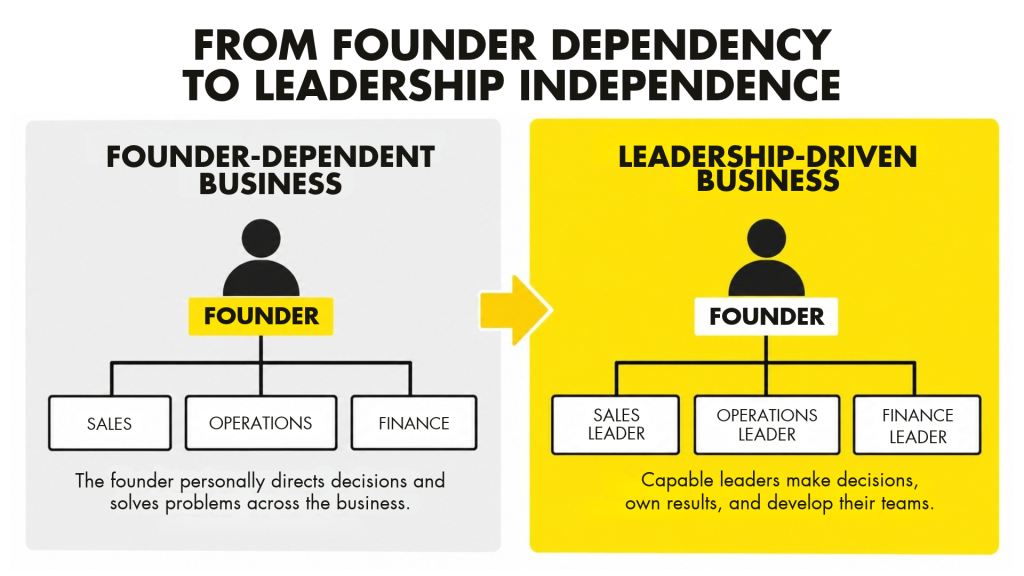
Scaling business leadership is the process of developing the people, management capabilities, decision-making structures, and leadership systems required for a company to grow without becoming increasingly dependent on its founder.
In a small business, the owner can often manage most important activities personally. As the organization expands, however, the number of employees, customers, decisions, and operational challenges increases.
If every decision continues to require the founder’s involvement, the business eventually reaches a capacity limit.
Scaling business leadership addresses that challenge by developing managers who can produce results, leaders who can guide departments, and systems that support consistent performance.
The objective isn’t to make the founder irrelevant. It’s to create a business where the founder contributes through direction, strategy, and leadership rather than personally controlling every activity.
Why Founder Dependency Limits Business Growth
Imagine a company where the owner approves every significant purchase, handles major customer complaints, makes the final hiring decision, and personally closes the largest sales opportunities.
The business might appear successful because problems are being solved and customers are receiving attention.
But what happens when the owner becomes unavailable?
Decisions slow down, employees wait for instructions, and opportunities may be delayed.
Scaling business leadership means reducing these unnecessary dependencies while maintaining appropriate oversight and accountability.
A scalable business should become more capable as its team grows, rather than requiring the founder to work increasingly longer hours.
1. Evolve Your Leadership as Your Business Grows
The first principle of scaling business leadership is understanding that the founder’s role must change as the company expands.
The skills required to launch a business aren’t necessarily the same skills needed to manage a growing organization.
Early success often comes from personal effort, technical knowledge, persistence, and the ability to solve problems quickly.
But as the business grows, results increasingly depend on your ability to develop other people.
The $1M Stage: From Individual Performer to Manager
Around the first million dollars in revenue, many founders are still heavily involved in day-to-day operations.
They may be the best salesperson, the most experienced technician, or the person who understands every major customer relationship.
At this stage, the business often operates through the owner’s personal knowledge and effort.
The challenge is to begin creating reliable processes and developing employees who can take responsibility for recurring activities.
Scaling business leadership starts when the founder recognizes that personal productivity alone cannot support unlimited growth.
The $10M Stage: From Manager to Leader of Managers
As a business moves toward $10 million, managing individual employees becomes increasingly difficult.
The organization needs managers who can lead teams, monitor performance, solve operational problems, and make appropriate decisions independently.
The founder’s role shifts toward developing those managers and ensuring they have the systems, resources, and authority required to succeed.
Instead of supervising every employee, the owner begins managing through a leadership structure.
Scaling business leadership at this stage means building management capability throughout the organization.
The $100M Stage: From Leader of Managers to Leader of Leaders
Moving toward $100 million requires another significant change.
At this level, the founder generally cannot personally supervise every department, location, or management team.
The organization needs senior leaders who can develop other managers, make strategic decisions, and maintain performance across larger areas of responsibility.
The founder’s focus increasingly shifts toward vision, organizational direction, executive development, culture, and long-term strategy.
Scaling business leadership becomes less about personally managing execution and more about developing an organization capable of managing itself.
The Three Stages of Leadership Evolution
| Business Stage | Founder’s Typical Role | Leadership Requirement |
|---|---|---|
| Around $1M | Operator and problem-solver | Establish reliable processes and basic management |
| Toward $10M | Leader of managers | Develop managers who own team performance |
| Toward $100M | Leader of leaders | Build executives who develop other leaders |
These revenue levels are illustrative rather than universal thresholds. Different industries and business models require different structures at different stages.
The important lesson is that scaling business leadership requires the founder to develop new capabilities as organizational complexity increases.
2. Identify and Eliminate Founder Bottlenecks
One of the most dangerous situations in business is becoming a very good bottleneck.
You’re capable, experienced, and effective at solving problems.
Employees trust your judgment, customers appreciate your involvement, and important decisions get made.
But the business becomes dependent on your ability to respond.
Scaling business leadership requires recognizing that solving every problem personally isn’t necessarily a sign of organizational strength.
The Hidden Cost of Being the Hero
Imagine a manager who encounters a difficult customer situation.
Instead of evaluating the options and making a decision within their authority, they immediately contact the owner.
The owner resolves the issue in five minutes.
That might seem efficient, but the manager hasn’t developed the ability to handle a similar situation independently.
The next time a problem appears, the same pattern repeats.
Scaling business leadership requires breaking this cycle so employees develop the judgment and confidence to handle appropriate responsibilities.
Conduct a Founder Dependency Audit
Ask yourself how many important activities still require your direct involvement.
| Business Activity | Founder Dependency Question |
|---|---|
| Sales | Do major deals require me to close them personally? |
| Pricing | Does my team need approval for routine pricing decisions? |
| Customer Service | Do difficult complaints automatically escalate to me? |
| Hiring | Am I involved in every recruitment decision? |
| Finance | Do managers need approval for routine spending? |
| Operations | Do recurring problems require my intervention? |
| Team Management | Can managers address performance issues independently? |
| Strategy | Does the team understand priorities without constant reminders? |
If most answers indicate heavy founder involvement, your business may have a leadership capacity problem.
That doesn’t mean every decision should be delegated.
Some decisions require owner or executive oversight because of their financial, legal, or strategic importance.
Scaling business leadership involves identifying which decisions genuinely require your involvement and which should be handled elsewhere.
Create Clear Decision-Making Authority
Employees need to understand what they can decide independently.
Establish appropriate boundaries around spending, customer service, operational changes, and team responsibilities.
For example, a customer service manager might have authority to resolve complaints within a defined financial limit.
An operations manager might be responsible for routine scheduling and resource allocation.
Scaling business leadership becomes more effective when decision rights are documented and understood.
Measure Independence, Not Just Performance
A team might produce good results while still depending heavily on the founder.
That means traditional performance measures don’t tell the entire story.
Also consider how many decisions are made without owner involvement, how frequently issues escalate, and whether managers can maintain performance during the founder’s absence.
Scaling business leadership should improve both business results and the organization’s ability to operate independently.
3. Replace the Hero Habit With Coaching and Empowerment
The third principle of scaling business leadership is changing how you respond when employees bring you problems.
Many entrepreneurs have developed a habit of immediately providing solutions.
They know the answer, so they give it.
That approach can save time in the moment, but it can prevent employees from developing their own problem-solving abilities.
Scaling business leadership requires learning when to provide direction and when to coach someone toward a decision.
Ask Better Questions Instead of Giving Every Answer
The next time an employee brings you a problem, try asking:
“What do you think we should do?”
That question changes the conversation.
Instead of immediately transferring responsibility to you, the employee has to consider the situation and propose a solution.
You can then ask follow-up questions about the options, risks, and expected outcomes.
Scaling business leadership involves developing the team’s ability to think through problems rather than simply follow instructions.
Use a Simple Coaching Framework
When an employee asks for help, guide the conversation through four questions:
- What’s the problem? Make sure the situation is clearly understood.
- What options have you considered? Encourage independent thinking.
- What do you recommend? Ask the employee to take a position.
- What will you do next? Establish ownership and accountability.
These questions won’t apply to every situation.
Urgent safety issues, legal concerns, or major financial risks may require immediate leadership intervention.
But for appropriate day-to-day decisions, coaching can become a powerful part of scaling business leadership.
Give People Room to Develop Judgment
Employees don’t become confident decision-makers simply by watching the founder make decisions.
They need opportunities to practice.
That includes making reasonable decisions, reviewing outcomes, receiving feedback, and learning from mistakes.
If every decision is reversed or criticized, employees may become reluctant to act independently.
Scaling business leadership requires creating appropriate opportunities for learning while maintaining clear standards and accountability.
Build a Culture of Ownership
A strong team doesn’t simply identify problems.
It takes responsibility for finding solutions.
Encourage employees to arrive with recommendations rather than only reporting difficulties.
Recognize thoughtful decision-making, even when the outcome isn’t perfect.
Provide constructive feedback and clarify what should happen differently next time.
Scaling business leadership becomes sustainable when employees understand that taking responsibility is part of their role.
Develop Smarter Rooms
Your objective shouldn’t be to remain the smartest person in every meeting.
It should be to develop a team capable of contributing knowledge, challenging assumptions, and solving problems collectively.
A strong leadership team brings different experiences and perspectives.
Scaling business leadership means creating an environment where those capabilities can influence decisions rather than waiting for the founder to provide every answer.
4. Hire People Who Are Better Than You at Their Jobs
Hiring is one of the most important decisions a growing business makes.
But many founders approach recruitment as a way to reduce their workload rather than expand organizational capability.
They hire someone to complete tasks the owner no longer has time to perform.
That can be useful, but scaling business leadership requires thinking beyond immediate workload relief.
The right hire can introduce knowledge, experience, and capabilities that the company doesn’t currently possess.
Hire for Capability, Not Just Capacity
Imagine a founder who has been personally managing marketing.
As the business grows, they decide to hire a marketing employee.
They could recruit someone who needs constant direction and approval.
Or they could recruit an experienced marketing leader who understands strategy, performance measurement, team development, and customer acquisition.
The second option may require a greater investment, but it can also introduce capabilities the founder doesn’t have.
Scaling business leadership involves hiring people who can take ownership of outcomes rather than simply complete assigned tasks.
Look for Experience Relevant to Your Next Stage
Think about hiring a tour guide.
Would you prefer someone who knows the city, understands the routes, and has guided hundreds of visitors?
Or someone who arrived yesterday and is reading the same guidebook as you?
Relevant experience can help people recognize challenges, make informed decisions, and avoid unnecessary mistakes.
The same principle applies to scaling business leadership.
An experienced finance leader, operations manager, or sales director may bring valuable knowledge about challenges your company is beginning to encounter.
Hire People Who Can Lead Their Functions
As your company expands, consider the capabilities required in major areas of the business.
| Business Function | Leadership Capability Needed |
|---|---|
| Marketing | Develop and manage customer acquisition processes |
| Sales | Build a sales team that produces consistent results |
| Finance | Support financial planning, reporting, and decision-making |
| Operations | Improve processes, productivity, and service delivery |
| Human Resources | Develop hiring, performance, and employee development systems |
| Customer Experience | Maintain service quality and customer relationships |
You don’t necessarily need a separate executive for every function immediately.
The structure should reflect your business size, complexity, and resources.
However, scaling business leadership requires identifying which capabilities will become essential as the organization grows.
Avoid Hiring People You Need to Control
Some founders feel uncomfortable hiring employees who know more than they do.
They may prefer people who follow instructions without questioning decisions.
But that approach can limit organizational capability.
A strong leader should welcome employees who bring deeper expertise in their areas of responsibility.
Scaling business leadership means being willing to delegate meaningful authority to capable people while maintaining appropriate accountability.
Develop the People You Already Have
Recruitment isn’t the only solution.
Existing employees may have the potential to become strong managers or leaders with the right training, experience, and support.
Evaluate their capabilities, aspirations, and readiness for greater responsibility.
Create development opportunities and provide clear performance expectations.
Scaling business leadership works best when recruitment and internal development support one another.
5. Understand the Difference Between Management and Leadership
Management and leadership are closely connected, but they serve different purposes.
Management focuses on organizing work, maintaining standards, developing competency, and achieving operational results.
Leadership focuses on direction, alignment, motivation, decision-making, and preparing people for future challenges.
A growing business needs both.
Scaling business leadership requires understanding when to manage performance and when to develop the organization’s capacity for growth.
Management Builds Current Performance
Managers help employees understand what needs to be done and how success will be measured.
They establish processes, clarify responsibilities, allocate resources, and monitor results.
For example, a sales manager might review conversion rates, coach sales techniques, and ensure the team follows an effective sales process.
These activities support consistent execution.
Scaling business leadership depends on managers who can maintain performance without constant founder involvement.
Leadership Develops Future Capability
Leadership looks beyond today’s tasks.
It helps people understand where the organization is going and what capabilities they’ll need to succeed.
A sales leader might develop future managers, improve the team’s strategic approach, and prepare the department for expansion.
That work builds capacity for tomorrow.
Scaling business leadership requires developing people who can guide change and prepare others for greater responsibility.
Management vs. Leadership
| Management | Leadership |
|---|---|
| Focuses on execution | Focuses on direction |
| Establishes processes | Communicates vision |
| Measures productivity | Develops future capability |
| Clarifies responsibilities | Creates alignment |
| Addresses current performance | Prepares people for growth |
| Maintains operational standards | Guides improvement and change |
These responsibilities overlap in practice.
Strong managers also lead, and strong leaders need management discipline.
The objective of scaling business leadership isn’t to separate the two completely but to ensure both capabilities develop as the company grows.
Evaluate Your Role in Employee Underperformance
When someone isn’t performing, it’s easy to assume the employee is the problem.
Sometimes that may be true.
But before reaching that conclusion, examine what the business has provided.
Ask whether the employee has:
- Clear expectations
- Appropriate training
- Necessary tools and systems
- Relevant performance measures
- Sufficient decision-making authority
- Constructive feedback
- Access to coaching and support
- Reasonable time to develop competency
If these foundations are missing, the organization may be contributing to the performance problem.
Scaling business leadership requires evaluating both individual accountability and the quality of the management environment.
Build Leaders Who Develop Other Leaders
At larger stages of growth, the founder cannot personally develop every employee.
Managers need to coach their teams, identify potential leaders, and prepare people for additional responsibilities.
Senior leaders must then support the development of those managers.
This creates a multiplying effect.
Scaling business leadership becomes more sustainable when leadership development is distributed throughout the organization.
6. Build the Organizational Structure Your Future Business Needs
The sixth principle of scaling business leadership is designing your organization for the company you want to build.
Most business owners create organizational structures around the employees they currently have.
They assign responsibilities based on availability and gradually add positions when workloads become unmanageable.
That approach may work temporarily, but it can create confusion and unnecessary founder dependency.
Scaling business leadership requires thinking about the structure your business will need in the future.
Draw Your Five-Year Organizational Chart
Imagine your company five years from now.
What size do you want it to become?
What departments will it need?
Who will be responsible for sales, marketing, operations, finance, customer experience, and people development?
Draw an organizational chart representing that future business.
Don’t begin by filling every position with the people you currently employ.
Start by identifying the roles and responsibilities the organization will require.
Scaling business leadership becomes more deliberate when you design the structure before deciding who should occupy each position.
Identify Every Box You Currently Occupy
Once you’ve created the future organizational chart, examine where you currently fit.
You might discover that you’re functioning as CEO, sales director, marketing manager, operations manager, and head of recruitment.
That doesn’t necessarily mean you’re doing those jobs poorly.
It means the business has several important functions dependent on one person.
Scaling business leadership involves developing a plan to transfer appropriate responsibilities to capable employees and managers.
Separate Roles From People
A role represents a set of responsibilities and expected outcomes.
A person is someone who may be capable of fulfilling that role.
These aren’t always the same thing.
An employee who performs well in their current position may need additional development before taking on a larger leadership role.
Likewise, the business may need capabilities that no current employee possesses.
Scaling business leadership requires evaluating positions based on what the organization needs rather than simply preserving existing arrangements.
Build a Leadership Development Roadmap
After identifying future roles, determine how those capabilities will be developed.
Some positions may be filled through internal promotion.
Others may require external recruitment, mentoring, professional development, or restructuring.
Create clear milestones for developing management and leadership capacity.
Scaling business leadership becomes more manageable when organizational development is treated as an ongoing process rather than an emergency response to growth.
Move Up and Out of Daily Operations
As capable managers and leaders take responsibility for their functions, the founder can gradually reduce involvement in routine operational decisions.
That creates more time for strategy, major relationships, organizational development, and long-term opportunities.
The transition should be deliberate.
Delegating responsibilities without training, authority, or accountability can create new problems.
Scaling business leadership requires transferring responsibility alongside the systems and support needed to succeed.
The Founder Dependency Test
One of the most useful ways to evaluate your company’s leadership capacity is to consider what would happen if you stepped away.
Imagine taking 30 days away from day-to-day operations.
You remain available for genuine emergencies and major decisions, but you’re no longer personally managing routine activities.
What would happen?
Would the sales team continue generating and closing appropriate opportunities?
Would managers handle customer concerns?
Would operational problems be resolved?
Would employees understand their priorities?
Would the company continue delivering its services consistently?
Scaling business leadership aims to improve the organization’s ability to function without constant founder involvement.
Rate Your Founder Dependency
| Area | Assessment Question |
|---|---|
| Sales | Can the team generate and close sales without me? |
| Operations | Can managers maintain daily performance? |
| Customer Service | Can appropriate issues be resolved independently? |
| Finance | Are routine financial decisions handled within clear limits? |
| Hiring | Can managers participate effectively in recruitment? |
| Accountability | Do employees know who owns each result? |
| Problem-Solving | Does the team propose solutions rather than wait for answers? |
| Leadership Development | Are managers actively developing other employees? |
Rate each area from 1 to 10 based on how independently it operates.
A low score identifies an opportunity to strengthen processes, authority, training, or leadership capability.
The purpose isn’t to eliminate the founder from every decision.
It’s to reduce unnecessary dependency while preserving appropriate governance and oversight.
The Scaling Business Leadership Scorecard
Use this scorecard to evaluate the leadership foundations required for sustainable growth.
| Leadership Capability | Question to Ask |
|---|---|
| Delegation | Are meaningful responsibilities assigned to capable people? |
| Decision-Making | Do managers have clear authority within appropriate boundaries? |
| Coaching | Do leaders develop judgment rather than provide every answer? |
| Management Systems | Are processes and performance expectations documented? |
| Hiring | Do we recruit for future capabilities as well as current needs? |
| Leadership Development | Are employees being prepared for greater responsibility? |
| Accountability | Does each important business outcome have a clear owner? |
| Organizational Structure | Have we defined the roles required for future growth? |
| Succession Planning | Can important responsibilities continue when key people are absent? |
| Founder Independence | Can the company operate without my constant involvement? |
Rate each capability from 1 to 10.
Then identify the areas where improvement would reduce founder dependency or strengthen organizational performance.
Scaling business leadership isn’t about achieving a perfect score immediately.
It’s about consistently developing the capabilities your company needs for its next stage.
Your 30-Day Leadership Scaling Challenge
You don’t need to transform your entire organization in one month.
Start by identifying where the business depends on you, then build a practical plan to develop greater independence.
Week 1: Identify Your Founder Bottlenecks
Track the decisions, approvals, and problems that reach you during a normal working week.
Record which activities genuinely require your involvement and which could be handled by someone else with appropriate training or authority.
Review the founder dependency assessment and identify recurring patterns.
This gives you a starting point for scaling business leadership.
Week 2: Introduce Coaching and Decision-Making Authority
Choose several recurring decisions that can be delegated safely.
Clarify the boundaries, expected outcomes, and escalation requirements.
When employees bring appropriate problems to you, begin asking what they recommend rather than immediately providing the answer.
Review their decisions and offer constructive feedback.
Scaling business leadership develops through repeated opportunities for employees to practice judgment.
Week 3: Assess Your Management Team
Review the capabilities of your current managers and potential future leaders.
Identify strengths, development needs, and important gaps.
Consider which responsibilities could be expanded through training and which may eventually require recruitment.
Develop a short list of leadership capabilities your business needs to strengthen.
Scaling business leadership should be supported by realistic development plans rather than assumptions about employee readiness.
Week 4: Design Your Five-Year Organizational Chart
Draw the structure your business may need five years from now.
Identify major functions, reporting relationships, and leadership responsibilities.
Then mark the positions you’re currently filling yourself.
Choose one or two responsibilities that could begin transitioning to capable team members.
Establish a development plan, timeline, and measures of success.
Scaling business leadership becomes more achievable when future organizational needs are translated into practical actions.
Stop Being the Bottleneck. Start Building Leaders.
The biggest limitation in a growing business isn’t always the market, the competition, or the availability of opportunities.
Sometimes it’s the founder’s inability to let the organization develop beyond their personal capacity.
When every decision, problem, and important customer relationship depends on you, the company can only move as fast as you do.
That’s not sustainable scalability.
Scaling business leadership requires a different definition of success.
Instead of measuring how many problems you personally solve, measure how effectively your team solves problems.
Instead of being proud that nobody can make a decision without you, develop managers who can make sound decisions independently.
Instead of hiring people simply to reduce your workload, recruit and develop people who expand the organization’s capabilities.
The transition begins with understanding how your role must evolve.
At the early stages, you may be the operator who delivers results through personal effort.
As the business grows, you need managers who can deliver results through their teams.
At larger stages, you need leaders who develop other leaders and maintain performance across the organization.
Scaling business leadership connects these stages through coaching, delegation, recruitment, management systems, and organizational development.
The ultimate measure of your leadership isn’t how much your business can accomplish because of you. It’s how much your people can accomplish without depending on you.
Build capable people, and those people can help build a stronger business.
That’s how you move from owning a company that depends on your daily effort to developing an organization capable of sustainable growth.
In this episode of The $100M Entrepreneur Podcast, I explain why scaling business leadership is essential for entrepreneurs who want to grow beyond founder dependency.
We explore the leadership evolution from $1 million toward $10 million and $100 million, why being the company’s best problem-solver can become a bottleneck, and how coaching helps employees develop independent judgment.
I also discuss the importance of hiring experienced leaders, understanding the difference between management and leadership, and designing an organizational structure that supports future growth.
Listen to or watch the full episode of The $100M Entrepreneur Podcast to discover how scaling business leadership can help you develop stronger managers, empower your team, reduce owner dependency, and build a business capable of growing beyond your personal capacity.

- Why Your Sales Process is Failing (And How to Fix It) - November 18, 2026
- Train Them Or Lose Them - November 17, 2026
- The First 90 Days: How to Turn New Hires Into High-Performing Employees - November 16, 2026