

Most business owners don’t start looking for employees until something goes wrong. Someone resigns, the workload becomes unmanageable, or the business suddenly needs more people to handle growing demand. Then the panic begins. Job advertisements go up, interviews get rushed, and the biggest question becomes, “Who can start on Monday?” The problem is that hiring under pressure often leads to decisions based on availability rather than capability. That’s why developing a recruitment strategy for business growth is so important.
I’ve worked with business owners who spend enormous amounts of time trying to find the right people, yet they approach recruitment as something they only need to think about when a position becomes vacant. They wouldn’t run their marketing that way. They wouldn’t wait until they had no customers before trying to generate leads. Yet that’s exactly how many companies approach talent acquisition. A recruitment strategy for business growth changes that thinking by making recruitment an ongoing business process rather than an occasional emergency.
In this episode of The $100M Entrepreneur Podcast, I explain why the businesses that scale successfully need to think differently about finding and attracting people. We’ll explore the difference between hiring and recruiting, how to build a continuous talent pipeline, why employer branding matters, and how to recruit for the business you’re becoming rather than the one you’re running today. Most importantly, I’ll show you how a recruitment strategy for business growth can help you build the team, leadership capabilities, and organizational strength required for long-term success.
What Is a Recruitment Strategy for Business Growth?
A recruitment strategy for business growth is a proactive approach to identifying, attracting, evaluating, and developing relationships with potential employees before the business urgently needs to fill positions.
Instead of treating recruitment as a reaction to vacancies, the business creates an ongoing process for finding people who possess the skills, experience, values, and potential required for future success.
The objective isn’t simply to fill open jobs faster. It’s to develop access to capable people who can strengthen the organization as it grows.
A recruitment strategy for business growth connects talent acquisition with business planning, organizational development, and long-term performance.
The Difference Between Hiring and Recruiting
Hiring and recruiting are related, but they aren’t the same thing.
Hiring is the process of selecting someone to fill a specific position. Recruiting is the broader activity of identifying and developing relationships with people who may become valuable employees in the future.
| Hiring | Recruiting |
|---|---|
| Responds to an immediate vacancy | Builds a future talent pipeline |
| Often begins when someone leaves | Happens continuously |
| Focuses on current applicants | Develops relationships with potential candidates |
| Prioritizes immediate requirements | Considers future capabilities |
| Ends when the position is filled | Continues as the business grows |
Both activities are necessary, but relying exclusively on reactive hiring can create unnecessary pressure.
A recruitment strategy for business growth gives you more options because you’ve already begun identifying potential candidates before an urgent need arises.
Why Reactive Hiring Can Become Expensive
Imagine a company losing an experienced operations manager.
Without a recruitment pipeline, the owner may need to advertise the position immediately, review unfamiliar candidates, and make a decision while the remaining team struggles with additional responsibilities.
The urgency can encourage compromises in experience, capability, or role alignment.
If the wrong person is selected, the company may face additional training costs, performance problems, and another recruitment process.
A recruitment strategy for business growth helps reduce these risks by making talent identification and relationship-building part of normal business operations.
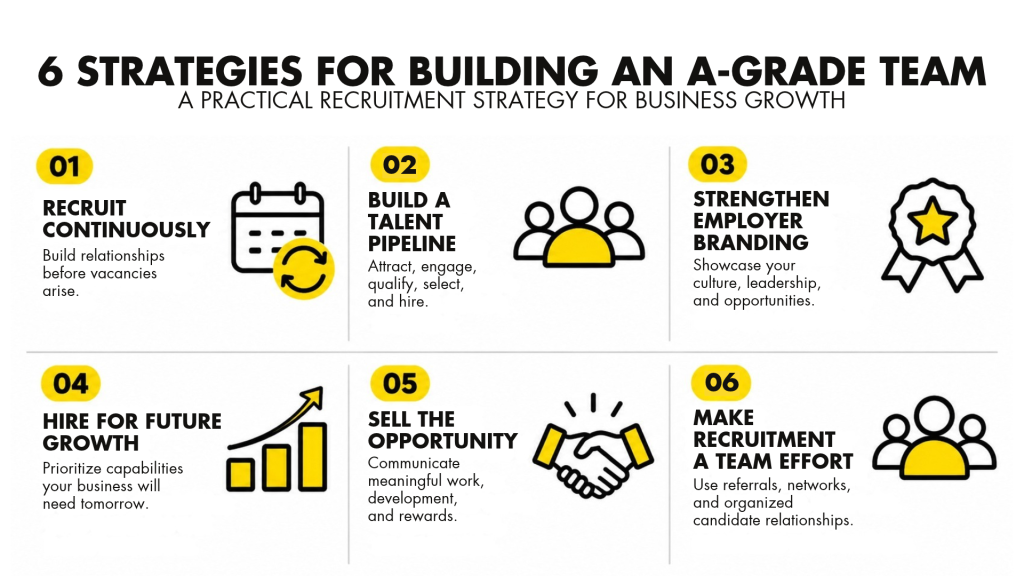
1. Stop Reactive Hiring and Build a Continuous Recruitment System
The first principle of a recruitment strategy for business growth is simple: don’t wait until you desperately need someone before you begin looking.
Most businesses understand the importance of maintaining a consistent flow of potential customers.
They invest in marketing, develop relationships, and build sales pipelines because they know revenue depends on having future opportunities.
Recruitment should operate with the same long-term mindset.
Why Great Candidates Aren’t Always Looking for Jobs
Some of the most capable people in your industry may already be employed.
They might be performing well, developing their skills, and building successful careers.
That doesn’t necessarily mean they’re unavailable for future opportunities.
They may be interested in a different leadership environment, greater responsibility, professional development, or a company whose direction aligns with their goals.
A recruitment strategy for business growth helps you establish professional relationships with these individuals before a specific vacancy exists.
Make Recruitment a Regular Business Activity
Instead of opening recruitment only when someone resigns, create a simple routine for identifying and connecting with potential candidates.
Managers might maintain relationships with professionals in their industries, attend relevant events, or participate in professional communities.
The business can also stay connected with promising former applicants who weren’t selected for previous positions.
These activities don’t require constant job offers or aggressive outreach.
A recruitment strategy for business growth can begin with regular relationship-building and an organized record of potential future candidates.
Build a Talent Bench Before You Need It
Think about the positions that would create the greatest disruption if someone left unexpectedly.
These might include sales managers, operations leaders, technical specialists, finance professionals, or customer service supervisors.
Identify the capabilities required for those positions and begin developing potential candidate relationships.
You may also have existing employees who could eventually move into those roles.
A recruitment strategy for business growth should consider both external talent and internal succession opportunities.
Recruitment Should Never Completely Stop
Even when your company isn’t actively hiring, you can continue strengthening your professional network.
Keep learning about talented people in your industry.
Maintain appropriate contact with potential candidates and stay aware of changes in your future workforce requirements.
The objective isn’t to accumulate hundreds of names.
It’s to develop a relevant network of people who may contribute to the organization’s future.
That’s how a recruitment strategy for business growth becomes an ongoing system rather than an emergency response.
2. Treat Recruitment Like Marketing and Build a Talent Pipeline
The second principle of a recruitment strategy for business growth is to recognize that attracting employees has similarities to attracting customers.
Marketing doesn’t assume everyone who sees an advertisement will immediately purchase.
It creates awareness, develops interest, builds credibility, and encourages qualified prospects to take the next step.
Recruitment can follow a similar process.
Understand the Recruitment Funnel
A practical recruitment funnel includes five stages:
Attract → Engage → Qualify → Select → Hire
Each stage serves a different purpose.
| Recruitment Stage | Primary Objective |
|---|---|
| Attract | Introduce potential candidates to your business |
| Engage | Develop relationships and communicate opportunities |
| Qualify | Understand relevant experience, capabilities, and interests |
| Select | Evaluate candidates against defined role requirements |
| Hire | Make an appropriate offer when a suitable position becomes available |
Not every person entering the recruitment funnel will become an employee.
Some candidates may not be suitable, while others may not be interested or available when a position opens.
A recruitment strategy for business growth creates a process for identifying the right people and maintaining appropriate relationships over time.
Use Multiple Sources to Find Potential Candidates
Many businesses rely almost entirely on job advertisements.
Job boards can be useful, but they shouldn’t be your only recruitment channel.
Potential candidates may come from:
- Professional networks
- Employee referrals
- Former applicants
- Industry associations
- Business partners
- Suppliers and customers
- LinkedIn and professional communities
- Networking events
- Educational institutions
- Existing employees with leadership potential
Different channels may produce different types of candidates.
A recruitment strategy for business growth evaluates which sources consistently connect the company with people who meet its requirements.
Build Relationships Before Making Offers
Imagine meeting an experienced sales manager at an industry event.
Your company doesn’t currently have a suitable position, but you’re impressed by their experience and approach to leadership.
Instead of forgetting the conversation, you maintain a professional connection.
Several months later, your business may be ready to expand its sales leadership team.
That relationship gives you a relevant person to contact, although they may or may not be interested.
A recruitment strategy for business growth creates these opportunities by treating candidate relationships as valuable long-term connections.
Measure the Quality of Your Talent Pipeline
A large list of potential candidates doesn’t automatically mean you have a strong recruitment system.
What matters is whether those people possess relevant capabilities and whether the company can engage them appropriately when opportunities arise.
Review the number of qualified prospects, the roles they may suit, and the strength of existing relationships.
A recruitment strategy for business growth should prioritize relevant talent rather than simply maximizing contact volume.
3. Build an Employer Brand That Attracts Great People
Recruitment isn’t only about evaluating candidates.
Candidates are also evaluating your business.
They want to understand what it’s like to work for your company, how people are treated, what opportunities exist, and whether the organization aligns with their professional goals.
That’s why employer branding is an essential part of a recruitment strategy for business growth.
Your Employer Brand Already Exists
Every company has an employer reputation, whether it manages that reputation intentionally or not.
Employees talk about their experiences.
Former employees share opinions.
Candidates form impressions through interviews, social media, professional networks, and company communications.
Your employer brand is shaped by what people experience and what they believe working for your organization would involve.
A recruitment strategy for business growth helps you communicate that experience clearly and accurately.
Show What Working for Your Company Looks Like
Don’t rely exclusively on job advertisements to introduce your business.
Use content to show the people, culture, leadership, and professional opportunities behind the organization.
Examples include employee interviews, behind-the-scenes videos, team development activities, leadership discussions, and stories about professional growth.
A company might share how employees receive training or how managers support team development.
These examples help potential candidates understand the working environment.
A recruitment strategy for business growth uses employer branding to attract people who are genuinely interested in the company.
Communicate a Clear Employee Value Proposition
An employee value proposition explains what people can reasonably expect in return for contributing their skills and effort to the organization.
Compensation is part of that proposition, but it isn’t the only consideration.
Potential employees may also value:
| Employee Consideration | Questions Candidates May Ask |
|---|---|
| Compensation | Is the salary and benefits package competitive? |
| Leadership | Will I work with capable and supportive managers? |
| Development | Can I learn new skills and advance professionally? |
| Autonomy | Will I have appropriate responsibility and decision-making authority? |
| Purpose | Does the work connect with something meaningful? |
| Recognition | Will strong performance be acknowledged? |
| Culture | Will I be treated respectfully and fairly? |
| Stability | Does the business have a credible direction and future? |
Different candidates will prioritize different factors.
A recruitment strategy for business growth should communicate the genuine strengths of your company rather than making promises you cannot deliver.
Make Your Employer Brand Consistent With Reality
You can publish attractive recruitment videos and talk about professional development, but those messages won’t create lasting value if employees experience something completely different.
If you promise autonomy, managers need to provide appropriate decision-making authority.
If you promote learning, employees need genuine opportunities to develop.
If you emphasize respect, that value must be reflected in daily behavior.
A recruitment strategy for business growth becomes stronger when employer branding accurately represents the employee experience.
Use Social Media to Support Recruitment
LinkedIn, company websites, and other relevant platforms can help potential candidates discover your organization.
Publish content that reflects your expertise, culture, and direction.
Share employee experiences where appropriate and explain the capabilities your business values.
Over time, this can help build familiarity with professionals who may consider joining the company in the future.
A recruitment strategy for business growth uses social media as a relationship-building and reputation-building tool, not simply a place to advertise vacancies.
4. Recruit for the Business You’re Becoming
One of the biggest recruitment mistakes is hiring exclusively for the problems your business has today.
You need someone to manage a workload, so you create a job description based on the tasks that currently need attention.
But what happens when your business doubles in size?
What happens when the team expands, customer expectations increase, or the organization enters new markets?
A recruitment strategy for business growth considers how roles may evolve as the company develops.
Start With the Role, Not the Person
Before evaluating candidates, define what the position needs to accomplish.
What results should the person produce?
What responsibilities will they own?
What capabilities are essential?
How will performance be measured?
These questions help prevent recruitment decisions based primarily on personality, familiarity, or availability.
A recruitment strategy for business growth begins with a clear understanding of the outcomes the company needs.
Define 12-Month Role Outcomes
Instead of writing job descriptions that contain only long lists of tasks, identify the results the person should achieve during their first year.
For example, a sales manager’s role might include:
| Role Component | Example Requirement |
|---|---|
| Primary Outcome | Improve sales team performance |
| Performance Measures | Conversion rate, revenue, pipeline quality |
| Leadership Responsibility | Coach and develop sales representatives |
| Process Responsibility | Maintain a consistent sales management process |
| Required Capability | Sales management and performance analysis |
| Behavioral Expectations | Accountability, communication, sound judgment |
| Future Requirement | Support a larger team as the business grows |
The specific measures should reflect the company’s business model and available resources.
A recruitment strategy for business growth uses these requirements to evaluate candidates against meaningful outcomes.
Understand How Growth Changes the Job
Consider an operations manager responsible for a small team serving a limited customer base.
If the business doubles, that manager may need stronger scheduling, delegation, reporting, and process management capabilities.
If the company grows tenfold, the position may require managing multiple teams, developing other managers, and coordinating more complex operations.
The job changes because the organization changes.
A recruitment strategy for business growth should anticipate these developments rather than assuming the same capabilities will always be sufficient.
Evaluate Future Potential Alongside Current Skills
Experience matters, but so does the ability to learn and adapt.
Some candidates may already possess the leadership experience required for the company’s next stage.
Others may have strong current capabilities and the potential to develop further.
Evaluate both factors carefully.
A recruitment strategy for business growth should consider demonstrated performance, relevant experience, learning ability, leadership potential, and alignment with the role’s requirements.
Build Succession Planning Into Recruitment
Succession planning involves preparing for changes in important positions.
Identify the roles that are critical to business continuity and evaluate whether internal employees could eventually assume those responsibilities.
Where gaps exist, consider external recruitment or development opportunities.
The goal isn’t to replace current employees unnecessarily.
It’s to ensure the organization has options when leadership requirements change.
A recruitment strategy for business growth connects hiring decisions with long-term organizational capability.
5. Sell the Opportunity, Not Just the Salary
Recruitment is a two-way decision.
Your company evaluates candidates, but candidates also decide whether your business is somewhere they want to work.
Highly capable professionals may have several employment options.
They may compare compensation, responsibilities, leadership quality, professional development, and the company’s direction.
A recruitment strategy for business growth recognizes that attracting talent requires communicating a compelling and credible opportunity.
Understand What Candidates Value
Money matters.
Employees need fair compensation that reflects the responsibilities of the position and relevant market conditions.
But compensation alone may not be enough to attract and retain the people your business needs.
Some candidates want greater responsibility.
Others prioritize professional development, supportive leadership, flexibility, meaningful work, or the opportunity to contribute to a growing organization.
A recruitment strategy for business growth requires understanding what matters to the specific people you’re trying to attract.
Explain the Opportunity Clearly
When discussing a role, go beyond the job title and salary.
Explain the problems the person will help solve, the outcomes they’ll be responsible for, and how the position contributes to the company’s future.
Describe the team they’ll work with, the leadership structure, and the support available.
Be transparent about challenges as well as opportunities.
A recruitment strategy for business growth should help candidates make informed decisions about whether the position suits their goals and capabilities.
Create a Professional Candidate Experience
The recruitment process itself communicates something about your company.
Disorganized interviews, unclear expectations, unnecessary delays, and poor communication can discourage strong candidates.
Establish a clear selection process.
Communicate the stages involved, provide reasonable updates, and treat applicants respectfully.
A recruitment strategy for business growth should reflect the professionalism you expect from future employees.
Avoid Promising What You Can’t Deliver
It’s tempting to make a position sound more attractive by exaggerating career opportunities or organizational plans.
But unrealistic promises can damage trust and contribute to employee dissatisfaction.
If a role involves difficult challenges, explain them honestly.
If advancement opportunities depend on performance and future business needs, communicate that clearly.
A recruitment strategy for business growth should attract candidates through genuine opportunities rather than inflated expectations.
Remember That Retention Starts With Recruitment
A successful recruitment process doesn’t end when someone accepts an offer.
The expectations created during recruitment influence the employee’s experience after joining.
Clear role requirements, realistic job previews, and accurate communication can help new employees understand what success looks like.
A recruitment strategy for business growth should connect recruitment with onboarding, development, and retention.
6. Make Talent Acquisition Everyone’s Responsibility
Recruitment shouldn’t depend entirely on the business owner or human resources department.
Managers, employees, and professional networks can help identify people who may contribute to the company’s future.
This doesn’t mean everyone should make hiring decisions.
It means the organization can develop a broader approach to recognizing and recommending relevant talent.
A recruitment strategy for business growth becomes stronger when talent identification is supported throughout the company.
Encourage Employee Referrals
Your employees may know capable professionals from previous workplaces, educational institutions, or industry networks.
Create a straightforward process for recommending potential candidates.
Explain which capabilities the business is looking for and how referrals should be submitted.
If you offer referral incentives, establish clear eligibility and payment rules.
A recruitment strategy for business growth can use employee networks to expand access to potential candidates while maintaining consistent selection standards.
Maintain Relationships With Former Candidates
Someone who wasn’t selected for a previous position may still be suitable for a different opportunity.
Perhaps another applicant had more relevant experience at the time.
Perhaps the candidate’s skills didn’t match the original role but could be valuable elsewhere.
With appropriate permission, maintain contact with promising individuals who may be interested in future opportunities.
A recruitment strategy for business growth recognizes that an unsuccessful application doesn’t necessarily mean the professional relationship has no future value.
Build a Simple Talent CRM
You don’t need an expensive recruitment platform to begin organizing candidate relationships.
A spreadsheet or appropriate recruitment system can provide a useful starting point.
| Talent CRM Field | Information to Record |
|---|---|
| Candidate Name | Name and permitted contact information |
| Professional Expertise | Relevant skills and experience |
| Source | Where the connection originated |
| Strengths | Why the candidate may be suitable |
| Potential Role | Positions that may match their capabilities |
| Last Contact | Date and context of the latest interaction |
| Candidate Interest | Relevant preferences or availability, if shared |
| Next Step | Appropriate follow-up activity |
Candidate information should be collected, stored, and retained in accordance with applicable privacy requirements.
A recruitment strategy for business growth benefits from organized information, but relationships should remain respectful and professional.
Keep the Talent Pipeline Active
Review your candidate network regularly.
Update relevant information, identify potential gaps, and maintain appropriate contact with promising professionals.
As the business changes, the types of capabilities you need may also change.
A recruitment strategy for business growth should evolve alongside the company’s direction and organizational requirements.
Give Your Business More Choice
The greatest benefit of a maintained recruitment pipeline is having more options.
Instead of beginning every search from zero, you may already know professionals worth contacting.
That doesn’t guarantee immediate availability or a successful hire.
But it can improve your ability to identify suitable candidates without relying exclusively on emergency job advertisements.
A recruitment strategy for business growth creates a more deliberate approach to building the team.
How to Measure Recruitment Effectiveness
Recruitment should be measured like any other important business process.
Without meaningful data, it’s difficult to understand whether your recruitment activities are attracting suitable candidates or supporting long-term performance.
A recruitment strategy for business growth should include a practical set of indicators that reflect both efficiency and quality.
| Recruitment Metric | What It Measures |
|---|---|
| Qualified Candidates | Number of candidates meeting defined role requirements |
| Time to Fill | Time required to fill an open position |
| Source of Hire | Recruitment channels producing successful hires |
| Offer Acceptance Rate | Percentage of offers accepted |
| New-Hire Retention | Percentage of employees remaining after a defined period |
| Quality of Hire | Performance against role-specific expectations |
| Pipeline Coverage | Availability of relevant prospects for priority roles |
| Internal Promotion Rate | Proportion of positions filled through internal development |
These measures should be interpreted together.
For example, reducing time to fill isn’t necessarily an improvement if new hires consistently fail to meet performance expectations.
A recruitment strategy for business growth balances speed, quality, candidate experience, and organizational needs.
Focus on Quality of Hire
Quality of hire can be more difficult to measure than recruitment speed.
However, it’s essential to understanding whether the company is selecting suitable people.
Consider evaluating performance against defined role outcomes, progress during onboarding, manager feedback, and employee retention.
Use consistent, job-related criteria rather than relying exclusively on subjective impressions.
A recruitment strategy for business growth should prioritize employees who contribute meaningfully to the organization over simply filling positions quickly.
The Recruitment Strategy for Business Growth Scorecard
Use this scorecard to evaluate the strength of your current recruitment process.
Rate each area from 1 to 10 based on how effectively your business performs.
| Recruitment Capability | Self-Assessment Question |
|---|---|
| Proactive Recruitment | Do we identify potential candidates before vacancies arise? |
| Talent Pipeline | Do we maintain relationships with qualified professionals? |
| Employer Branding | Do candidates understand what makes our company attractive? |
| Role Clarity | Are positions defined by outcomes and responsibilities? |
| Future Planning | Do we recruit for capabilities required by future growth? |
| Candidate Experience | Is our selection process clear and professional? |
| Employee Referrals | Do team members have a way to recommend talent? |
| Succession Planning | Are we preparing for changes in important positions? |
| Talent CRM | Do we organize candidate relationships appropriately? |
| Recruitment Measurement | Do we track hiring quality and effectiveness? |
The objective isn’t to achieve a perfect score immediately.
Identify the areas creating the greatest risk or limiting your ability to attract suitable employees.
Then prioritize improvements that support your company’s future requirements.
A recruitment strategy for business growth becomes more effective when you regularly review and strengthen the process.
Your 30-Day Recruitment Strategy Challenge
You don’t need to build a sophisticated recruitment department to begin improving how your business attracts people.
Start with a simple system that can develop as the organization grows.
Week 1: Audit Your Current Recruitment Process
Review how your company currently identifies and hires employees.
How often does recruitment begin only after someone leaves?
Which positions are most difficult to fill?
Where do your strongest employees typically come from?
Identify critical roles and consider the capabilities your business may need over the next 12 to 24 months.
This assessment creates the foundation for a recruitment strategy for business growth.
Week 2: Define Future Roles and Build Your Initial Pipeline
Choose several important positions and document their expected outcomes.
Identify essential capabilities, relevant experience, behavioral expectations, and performance measures.
Then begin creating a list of professionals who may be suitable for future opportunities.
Include appropriate contacts from your existing network, professional communities, and previous recruitment activities.
A recruitment strategy for business growth becomes more practical when future talent requirements are clearly defined.
Week 3: Strengthen Employer Branding and Referrals
Review how your company presents itself to potential employees.
Does your website communicate what it’s like to work there?
Do your social media channels reflect the company’s culture, leadership, and professional opportunities?
Develop a few pieces of authentic employer branding content.
Explain to employees how they can recommend potential candidates.
A recruitment strategy for business growth should make it easier for suitable professionals to discover and understand your organization.
Week 4: Establish Your Talent CRM and Recruitment Dashboard
Create a simple system for organizing candidate relationships.
Record relevant information, potential roles, and appropriate follow-up activities.
Then establish a recruitment dashboard with a few meaningful measures.
Start with qualified candidates, recruitment sources, time to fill, and new-hire performance.
Schedule regular reviews to update the pipeline and evaluate future requirements.
A recruitment strategy for business growth becomes sustainable when these activities are incorporated into normal business operations.
Stop Filling Vacancies. Start Building Your Future Team.
Most businesses don’t fail to attract great people because talented professionals don’t exist.
They struggle because they only begin looking when the pressure becomes urgent.
An employee resigns, the workload increases, and suddenly recruitment becomes an emergency.
That’s not a reliable way to build a company capable of sustainable growth.
A recruitment strategy for business growth requires a different mindset.
Instead of treating recruitment as an occasional activity, make it a continuous process.
Build relationships with potential candidates before positions become available.
Communicate why your business is worth joining.
Define roles around meaningful outcomes and recruit for the capabilities your future organization will require.
Remember that candidates are evaluating your company just as carefully as you’re evaluating them.
Develop an employee experience that supports the promises you make during recruitment.
Encourage referrals, maintain professional relationships, and organize your talent pipeline so you have more options when hiring needs arise.
Hiring fills the position you have today. Recruiting builds the team your business will need tomorrow.
A strong recruitment strategy for business growth isn’t simply about finding employees faster.
It’s about developing access to capable people who can strengthen your company, improve performance, and support its next stage of development.
When you consistently recruit for the future, you’re not just filling jobs.
You’re building one of the most valuable competitive advantages a business can have: an extraordinary team working effectively together.
Listen to the Full Episode of The $100M Entrepreneur Podcast
In this episode of The $100M Entrepreneur Podcast, I explain why a recruitment strategy for business growth should be an ongoing business system rather than a reaction to employee resignations or increasing workloads.
We explore the difference between hiring and recruiting, how to build a talent pipeline, why employer branding matters, and how to attract people who can help your business grow into its next stage.
I also discuss why recruitment should be treated like marketing, how to define roles around future business outcomes, and why the strongest candidates need a compelling reason to join your organization.
Listen to or watch the full episode of The $100M Entrepreneur Podcast to discover how a recruitment strategy for business growth can help you attract stronger candidates, reduce emergency hiring, and build a team capable of supporting long-term business success.

- Why Your Sales Process is Failing (And How to Fix It) - November 18, 2026
- Train Them Or Lose Them - November 17, 2026
- The First 90 Days: How to Turn New Hires Into High-Performing Employees - November 16, 2026