

You can hire the most talented people in your industry and still end up with a business that struggles to perform. Your salespeople might be excellent at closing deals, your marketing team might generate plenty of leads, and your operations team might work incredibly hard. But if everyone is pulling in different directions, all that individual talent won’t necessarily produce great results. Building high performing teams requires more than putting capable people together and hoping they’ll work well as a group.
I’ve worked with business owners who believe their biggest team problem is finding better employees. They spend more money on recruitment, introduce new incentives, and replace people who aren’t meeting expectations. Sometimes those changes are necessary, but often the real problem isn’t the people. It’s the way the team has been designed, led, and managed. High performing teams need shared direction, clear expectations, consistent leadership, and a system that turns individual effort into collective results.
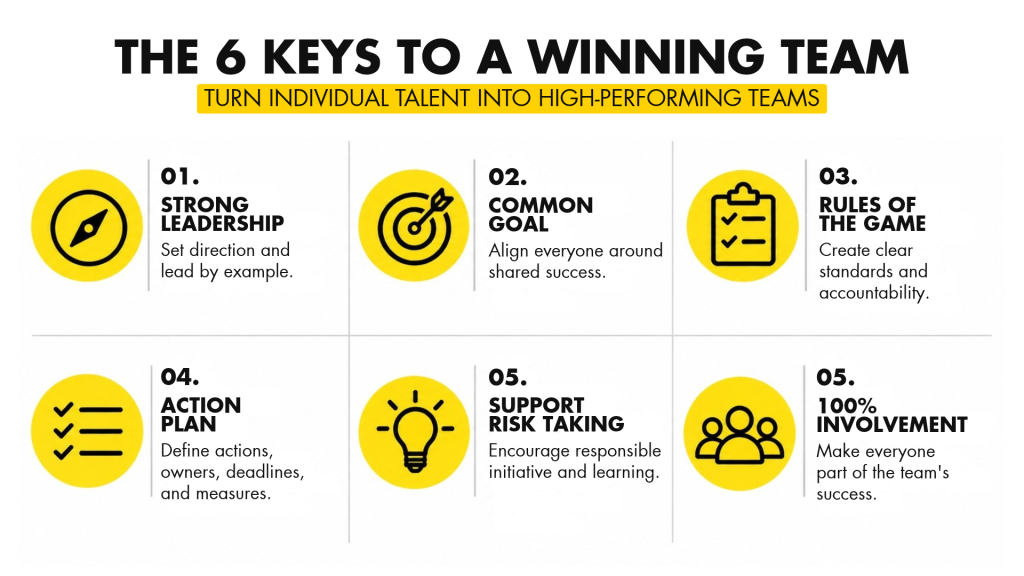
In this episode of The $100M Entrepreneur Podcast, I’m breaking down the six keys to building high performing teams that can consistently deliver results. We’ll look at how leadership influences behavior, why a common goal matters more than individual departmental targets, and how clear rules and action plans create accountability. I’ll also explain why responsible risk taking and full employee involvement are essential if you want a business where people solve problems together rather than constantly depending on the owner.
What Makes High Performing Teams Different?
A group of employees isn’t automatically a team.
People can work for the same company, attend the same meetings, and contribute to the same business without genuinely working together toward a shared result. They may be focused on their individual responsibilities without understanding how those responsibilities connect to everyone else’s work.
High performing teams operate differently. Their members understand the organization’s direction, know what success looks like, and recognize how their work contributes to a common objective.
They also understand the standards they’re expected to maintain and the responsibilities they share with other departments.
The Difference Between a Group and a Team
Consider a business with separate marketing, sales, operations, finance, and customer service departments.
Marketing wants more leads. Sales wants more revenue. Operations wants fewer disruptions. Finance wants lower costs. Customer service wants happier customers.
None of those objectives is necessarily wrong.
The problem appears when each department pursues its own targets without considering the overall business result.
Marketing might generate leads that sales cannot convert. Sales might promise delivery timelines that operations cannot meet. Finance might reduce spending in ways that negatively affect customer service.
High performing teams avoid these problems by connecting departmental responsibilities to shared business priorities.
| A Group of Employees | A High-Performing Team |
|---|---|
| Focuses mainly on individual tasks | Works toward a common result |
| Measures departmental success separately | Connects performance to shared outcomes |
| Operates in silos | Coordinates across departments |
| Relies on the owner to resolve conflicts | Uses shared priorities to guide decisions |
| Reacts when problems become serious | Identifies and addresses problems early |
| Sees accountability as an individual issue | Understands both individual and shared responsibility |
The difference isn’t simply how well people get along.
It’s whether their efforts are organized around the same definition of success.
Why Talented Employees Can Still Underperform Together
When teamwork breaks down, business owners often assume there’s a personality problem.
They might describe employees as difficult, unmotivated, or unwilling to cooperate.
Sometimes individual behavior genuinely needs to change. But before blaming people, examine whether the business has created the conditions required for effective teamwork.
Do employees understand the company’s priorities? Are responsibilities clear? Do departments share relevant information? Are managers reinforcing the same standards?
High performing teams need more than talent. They need an environment that makes cooperation, accountability, and consistent execution possible.
1. Strong Leadership: Set the Standard for Winning
The first key to building high performing teams is strong leadership.
Leadership isn’t about controlling every employee or making every decision yourself. It’s about creating the direction, clarity, and consistency people need to do their jobs effectively.
Your team needs to understand where the business is going, why that direction matters, and what behaviors are expected along the way.
Without that clarity, people start creating their own interpretations of what matters.
Make Winning Visible
Think about a sports team preparing for an important match.
Every player needs to understand the objective, their position, the strategy, and how their performance contributes to the result.
A business team needs the same clarity.
As the leader, you should be able to explain what the organization is trying to achieve, what success looks like, and which priorities matter most.
For high performing teams, winning cannot be something only the owner understands.
It needs to be visible and meaningful to everyone involved.
Lead Through Behavior, Not Just Instructions
One of the biggest leadership mistakes is expecting employees to follow standards the leader doesn’t demonstrate.
If you expect punctuality but regularly arrive late, your actions weaken the message.
If you demand excellent customer service but treat customers poorly when you’re frustrated, employees notice.
If you talk about accountability but avoid difficult conversations, the team learns that standards are negotiable.
High performing teams are influenced by what leaders consistently do, not simply what they say.
Culture develops through repeated behavior.
Create Consistent Expectations
Employees should understand which behaviors are acceptable and which aren’t.
That includes communication, customer care, professionalism, teamwork, and responsibility for results.
Standards should be applied fairly and consistently.
When expectations change depending on the situation or the person involved, confusion and frustration can develop.
High performing teams benefit from leaders who establish clear expectations and reinforce them through regular feedback and appropriate action.
Leadership Doesn’t Mean Being Authoritarian
Strong leadership doesn’t require employees to be afraid of making decisions.
In fact, excessive control can prevent people from developing the confidence and judgment required to perform independently.
The objective is to provide direction while giving employees appropriate responsibility.
Explain the desired outcome, establish boundaries, and make sure people understand when they can act independently and when they need additional guidance.
High performing teams need leaders who combine clear standards with trust and accountability.
Ask Yourself: Am I Modeling the Standards I Expect?
Before criticizing your team’s behavior, consider the example you’re setting.
Are you communicating clearly? Do you follow through on commitments? Are you consistent when dealing with customers and employees?
Leadership improvement often begins with examining your own behavior.
If you want high performing teams, demonstrate the standards you expect them to follow.
2. Common Goal: Give Everyone Something to Win Together
The second key to building high performing teams is having a common goal.
Many businesses have targets, but that doesn’t necessarily mean employees share a meaningful objective.
Sales might have a revenue target, marketing might have a lead generation target, and operations might have a productivity target.
Those measures can be useful, but employees also need to understand what the organization is collectively trying to accomplish.
A Common Goal Connects Different Roles
Imagine a company whose shared objective is to become the most reliable service provider in its market.
Marketing supports that goal by communicating realistic promises.
Sales supports it by setting accurate customer expectations.
Operations supports it by delivering consistently.
Customer service supports it by resolving issues professionally.
Finance supports it by helping the business maintain the resources required for reliable delivery.
Each department contributes differently, but everyone is working toward the same result.
That’s how high performing teams turn individual responsibilities into coordinated performance.
Make the Goal Meaningful Beyond the Owner
A revenue target may be important to the business owner, but employees may not automatically find it motivating.
People need to understand how the goal connects to customers, the organization’s purpose, and their own contribution.
For example, improving customer retention may mean delivering more reliable service, building stronger relationships, and creating a more stable business.
A compelling common goal helps employees understand why their work matters.
High performing teams are more likely to stay aligned when the shared objective has a clear purpose.
Try the 10-Employee Alignment Test
Here’s a simple exercise.
Ask ten employees the same question:
“What is our business trying to achieve?”
Don’t give them the answer beforehand. Let them explain it in their own words.
Then compare their responses.
If you receive ten completely different answers, your team may not have a clearly understood common goal.
If the answers reflect the same direction and priorities, that’s a useful sign of alignment.
High performing teams don’t need everyone to repeat identical words, but they should share a consistent understanding of what success means.
Use the Common Goal as a Decision-Making Filter
A clear goal also helps employees make better decisions.
When departments disagree about priorities, they can evaluate which option best supports the shared objective.
For example, if customer reliability is a central priority, the team can consider how proposed changes affect service quality and delivery commitments.
This reduces unnecessary conflict and helps managers make decisions without constantly escalating issues to the owner.
High performing teams use common goals to guide action, not simply decorate meeting rooms.
3. Rules of the Game: Create Clarity and Accountability
The third key to building high performing teams is establishing clear rules of the game.
Every successful team needs standards that explain how people are expected to work together.
These rules shouldn’t become an unnecessarily complicated employee handbook filled with instructions nobody remembers.
They should provide practical guidance about behavior, communication, responsibility, and decision-making.
Why Vague Values Aren’t Enough
Many businesses say they value accountability, teamwork, respect, and customer service.
Those are positive ideas, but they can mean different things to different people.
One employee might believe accountability means completing assigned tasks.
Another might believe it means taking responsibility for the final outcome, even when problems arise.
High performing teams need shared definitions that translate values into observable behavior.
Turn Values Into Clear Standards
| Vague Value | Clear Team Standard |
|---|---|
| Be accountable | Own commitments and communicate delays early |
| Respect others | Listen carefully and address concerns professionally |
| Deliver excellent service | Respond within agreed service standards |
| Work as a team | Share information that affects other departments |
| Be proactive | Raise problems early and recommend solutions |
| Communicate effectively | Provide relevant updates before deadlines are missed |
These standards give employees a clearer understanding of what good performance looks like.
They also make feedback and accountability more consistent.
High performing teams benefit when expectations are specific enough to guide everyday decisions.
Good Rules Create Freedom
Some business owners worry that rules will make their companies too rigid.
But unclear expectations can actually create more dependence on management.
When employees don’t know what they’re allowed to decide, they may ask for permission constantly.
Clear rules establish boundaries.
Within those boundaries, employees can act with greater confidence.
High performing teams don’t need the owner to approve every reasonable decision because the standards are already understood.
Apply the Rules Consistently
Rules lose their value when they’re enforced selectively.
If one employee is held accountable for missing deadlines while another repeatedly ignores commitments without consequences, resentment can develop.
The same applies when leaders exempt themselves from standards.
Consistency doesn’t mean ignoring individual circumstances or treating every situation identically.
It means applying fair principles and explaining expectations clearly.
High performing teams depend on trust that the rules matter and that everyone is responsible for maintaining them.
Review the Rules as the Business Changes
The standards that work for a small team may need refinement as the organization grows.
New departments, remote employees, larger customer volumes, and additional management layers can introduce different coordination challenges.
Review whether existing rules still support effective performance.
Keep the standards clear, practical, and relevant.
High performing teams maintain consistency while adapting their working practices to changing business needs.
4. Action Plan: Turn Goals Into Measurable Execution
The fourth key to building high performing teams is having an action plan.
A shared goal creates direction, but direction alone doesn’t produce results.
People need to know what must happen, who is responsible, when work should be completed, and how success will be measured.
Without those details, even motivated employees can become busy without making meaningful progress.
Turn Strategy Into Specific Commitments
A practical action plan answers five questions:
Goal → Action → Owner → Deadline → Success Measure
Suppose your business wants to improve customer retention.
That objective needs to become a set of measurable activities.
| Component | Example |
|---|---|
| Goal | Improve customer retention |
| Action | Introduce a structured customer follow-up process |
| Owner | Customer service manager |
| Deadline | Within 30 days |
| Success Measure | Follow-up completion and retention performance |
The specific targets should reflect your current performance and business requirements.
High performing teams turn broad objectives into commitments that employees can understand and manage.
Give Every Important Result an Owner
One of the biggest execution problems occurs when everyone assumes someone else is responsible.
A project might involve several departments, but accountability for the final outcome should still be clear.
Identify who coordinates the work, who contributes, and who has authority to make decisions.
That doesn’t mean one person must complete every task.
It means responsibility for progress and results isn’t left undefined.
High performing teams know who owns each important commitment.
Use a Visible Team Scoreboard
Imagine playing a game without knowing the score.
You might work hard, but you wouldn’t know whether your actions were moving you closer to winning.
Business teams face a similar problem when performance information arrives too late.
If employees discover they missed their targets months after the fact, they lose opportunities to make timely adjustments.
High performing teams need relevant feedback that shows whether their actions are producing the desired results.
Example Team Performance Scoreboard
| Business Area | Example Performance Measure | Connection to Shared Results |
|---|---|---|
| Marketing | Qualified leads | Attract suitable potential customers |
| Sales | Conversion rate | Turn opportunities into customers |
| Operations | Delivery time and quality | Fulfill customer expectations |
| Customer Service | Satisfaction and resolution time | Strengthen customer relationships |
| Finance | Profitability and cash flow | Support financial sustainability |
| Team Performance | Shared commitments completed on time | Improve cross-functional execution |
The objective isn’t to overwhelm employees with dozens of metrics.
Choose a manageable number of measures that reflect the company’s priorities and that employees can meaningfully influence.
High performing teams use scoreboards to guide improvement rather than simply report past results.
Review Progress Regularly
A scoreboard only becomes useful when people discuss what the numbers mean.
Hold regular reviews to identify progress, obstacles, and necessary adjustments.
Ask what’s working, what isn’t working, and what support the team needs.
When performance falls short, focus on understanding the causes and agreeing on corrective action.
High performing teams use feedback to improve execution before small problems become major setbacks.
5. Support Risk Taking: Build a Team That Learns and Improves
The fifth key to building high performing teams is supporting responsible risk taking.
If employees believe every mistake will result in criticism or punishment, they may become reluctant to suggest ideas or make decisions.
Instead, they’ll wait for instructions and avoid situations where outcomes are uncertain.
That might reduce some short-term mistakes, but it can also limit learning and improvement.
Create Psychological Safety Without Removing Accountability
Psychological safety means employees can raise concerns, ask questions, and contribute ideas without unnecessary fear of embarrassment or retaliation.
It doesn’t mean every decision is acceptable or that performance standards disappear.
Employees still need to follow appropriate procedures, respect financial limits, and take responsibility for their actions.
High performing teams combine openness to learning with clear accountability.
Encourage Responsible Experiments
Suppose an employee suggests a new way to improve customer response times.
Rather than immediately rejecting the idea, a manager could ask how the change might work, what resources it requires, and how success would be measured.
The team might test the idea on a limited basis before implementing it more broadly.
That creates an opportunity to learn without exposing the entire business to unnecessary risk.
High performing teams develop new approaches through thoughtful experimentation.
Coach the Thinking Process
When an employee makes a decision that doesn’t produce the expected result, the leader has an opportunity to coach.
Ask what information was available, which options were considered, and what assumptions influenced the decision.
Then discuss what could be done differently next time.
This approach helps employees improve their judgment.
High performing teams become stronger when leaders develop problem-solving ability rather than simply taking control whenever something goes wrong.
Distinguish Intelligent Risks From Careless Decisions
Supporting initiative doesn’t mean encouraging employees to ignore procedures or take unnecessary risks.
An intelligent risk involves a clear objective, reasonable preparation, appropriate authority, and consideration of potential consequences.
A careless decision ignores important information, established boundaries, or foreseeable harm.
Leaders need to explain that distinction.
High performing teams are willing to improve existing methods while maintaining responsibility for customers, employees, and business resources.
Recognize Learning and Initiative
If employees only receive recognition when everything goes perfectly, they may avoid worthwhile challenges.
Recognize thoughtful suggestions, responsible problem-solving, and improvements that benefit the business.
When an experiment doesn’t succeed, evaluate what was learned and whether the approach should change.
High performing teams develop a culture where improvement is encouraged and lessons are applied.
6. 100% Involvement and Inclusion: Make Everyone Part of the Win
The sixth key to building high performing teams is 100% involvement and inclusion.
That doesn’t mean every employee needs to attend every meeting or participate in every decision.
It means everyone should understand how their role contributes to the company’s success and have appropriate opportunities to improve the work they influence.
A strong team doesn’t have spectators who believe business performance is someone else’s responsibility.
Everyone Influences Business Results
Salespeople are directly responsible for generating revenue, but they aren’t the only employees who influence it.
Marketing affects the quality of customer opportunities.
Operations affects delivery and reliability.
Customer service influences satisfaction and repeat business.
Finance helps maintain the resources required to support growth.
Administrative employees contribute through organization, accuracy, and efficiency.
High performing teams understand that business results are created through the combined efforts of different functions.
Break Down Departmental Silos
Silos develop when departments focus exclusively on their own priorities.
Employees may protect information, avoid collaboration, or view other departments as obstacles.
To reduce these problems, create opportunities for teams to understand how their work affects one another.
For example, marketing and sales can review lead quality together.
Sales and operations can discuss customer expectations before commitments are made.
Customer service can share recurring complaints with the departments responsible for resolving their underlying causes.
High performing teams coordinate across functions instead of treating departmental boundaries as barriers.
Involve Employees in Improvement
The people doing the work often understand recurring problems that managers may not see.
Ask employees where processes create delays, where customers experience frustration, and which activities could be improved.
Encourage practical suggestions and explain how decisions will be made.
Not every idea will be implemented, but employees should know their observations are taken seriously.
High performing teams benefit from the knowledge and experience of people throughout the organization.
Make Accountability Shared but Specific
Collective responsibility doesn’t mean individual accountability disappears.
Every employee should understand their own commitments while recognizing how those commitments affect others.
For example, if a customer delivery fails because information wasn’t transferred correctly between departments, the solution may require several people to improve the process.
The objective is to identify responsibilities and fix the underlying issue rather than simply assign blame.
High performing teams take ownership of both individual contributions and shared outcomes.
Celebrate Team Results
Recognition can reinforce the behaviors that support teamwork.
When a company achieves an important milestone, acknowledge the contributions of different departments and individuals.
Highlight collaboration, initiative, customer service, and reliable execution.
This helps employees see that success isn’t limited to the most visible positions.
High performing teams develop pride in what they accomplish together.
How the Six Keys Work Together
Each of the six keys contributes something different to team performance.
Strong leadership establishes direction and standards.
A common goal creates alignment.
Rules of the game clarify expected behavior.
An action plan turns priorities into measurable commitments.
Support for responsible risk taking encourages learning and improvement.
Full involvement connects everyone’s contribution to the overall result.
| Key | What It Creates | What Happens When It’s Missing |
|---|---|---|
| Strong Leadership | Clarity and consistency | Confusion and inconsistent standards |
| Common Goal | Shared direction | Competing departmental priorities |
| Rules of the Game | Clear expectations | Misunderstandings and weak accountability |
| Action Plan | Measurable execution | Activity without consistent progress |
| Support Risk Taking | Initiative and learning | Fear of mistakes and limited improvement |
| 100% Involvement | Ownership and collaboration | Silos and disengagement |
High performing teams emerge when these elements reinforce one another.
Strong leadership without a common goal can become directionless control.
A common goal without an action plan can become little more than an aspiration.
An action plan without involvement may produce compliance without ownership.
The six keys work best as a connected system.
The High Performing Teams Scorecard
Here’s a practical exercise you can use to evaluate your business.
Rate each of the six keys from 1 to 10, where 1 means the area requires significant improvement and 10 means it is consistently demonstrated throughout the organization.
| Key | Self-Assessment Question | Score |
|---|---|---|
| Strong Leadership | Do leaders consistently communicate and model expectations? | /10 |
| Common Goal | Can employees explain the organization’s shared objective? | /10 |
| Rules of the Game | Are behavioral and performance standards clearly understood? | /10 |
| Action Plan | Does every important objective have an owner, deadline, and measure? | /10 |
| Support Risk Taking | Can employees suggest improvements and learn from responsible mistakes? | /10 |
| 100% Involvement | Does everyone understand how their work contributes to success? | /10 |
Your total possible score is 60.
The score isn’t a scientific measure of team performance. It’s a practical discussion tool to help identify areas that may need attention.
Identify Your Weakest Key
Once you’ve completed the assessment, look at the lowest-scoring area.
If leadership scores highly but the action plan scores poorly, employees may understand the direction without having clear execution priorities.
If the common goal scores poorly, departments may be working toward conflicting outcomes.
If involvement is weak, employees may not feel responsible for improving results beyond their immediate tasks.
High performing teams improve when leaders address the specific weaknesses limiting coordination and execution.
Improve One or Two Points This Quarter
You don’t need to transform every aspect of teamwork immediately.
Choose the weakest key and identify practical actions that could improve its score by one or two points over the next quarter.
For example, if your action plan scores 5 out of 10, introduce clearer ownership, weekly progress reviews, and a visible scoreboard.
If involvement scores 4 out of 10, establish regular opportunities for employees to contribute improvement ideas and participate in solving relevant problems.
High performing teams are developed through consistent improvement rather than occasional motivational activities.
Your 30-Day High Performing Teams Challenge
The six keys become valuable when they’re translated into everyday business practices.
Here’s a simple 30-day challenge to help you begin strengthening teamwork.
Week 1: Evaluate Leadership and Your Common Goal
Start by reviewing whether leaders consistently demonstrate the standards they expect.
Ask employees to explain the company’s main objective and compare their answers.
Identify areas where communication is unclear or departmental priorities are competing.
Use the results to clarify what winning means for the organization.
Building high performing teams starts with creating a shared understanding of direction and expectations.
Week 2: Establish Your Rules of the Game
Review the behaviors and standards that matter most to your business.
Define clear expectations for communication, accountability, customer care, and collaboration.
Involve appropriate team members in discussing how those standards should work in practice.
Then communicate the rules and explain how they’ll be reinforced.
High performing teams benefit when everyone understands the expectations that guide daily behavior.
Week 3: Build Your Action Plan and Scoreboard
Choose a shared business objective and break it into specific actions.
Assign owners, deadlines, and relevant measures.
Create a simple scoreboard that shows progress toward the objective.
Schedule regular reviews to discuss results, obstacles, and improvements.
High performing teams need a practical connection between goals and execution.
Week 4: Encourage Initiative and Full Involvement
Invite employees to identify problems and suggest improvements within their areas of responsibility.
Choose an appropriate idea to test, establish boundaries, and review the outcome.
Recognize contributions from different departments and discuss what the team learned.
At the end of the month, repeat the six-key assessment and identify the next area for improvement.
High performing teams develop through ongoing participation, feedback, and shared responsibility.
Stop Managing Individuals. Start Building a Team.
One of the biggest mistakes business owners make is assuming that hiring talented people automatically creates a successful team.
It doesn’t.
You can have excellent employees who struggle to collaborate because the organization lacks clear direction, consistent standards, or effective execution.
You can have hardworking departments that produce disappointing results because everyone is focused on different priorities.
And you can have capable managers who constantly escalate problems because employees don’t understand the boundaries within which they can make decisions.
High performing teams require deliberate design.
Start with strong leadership that demonstrates the standards you expect.
Create a common goal that gives everyone something meaningful to work toward.
Establish clear rules of the game so people understand how to behave, communicate, and take responsibility.
Translate the goal into an action plan with measurable commitments and a visible scoreboard.
Support responsible risk taking so employees develop confidence, judgment, and the ability to improve how work gets done.
Finally, make sure everyone understands their contribution to the business and has appropriate opportunities to participate in its success.
Great employees don’t automatically create a great team. Great leadership creates the conditions for talented people to achieve great results together.
When these six keys become part of the way your business operates, teamwork stops depending on personalities or occasional bursts of motivation.
It becomes a repeatable system for alignment, accountability, collaboration, and performance.
That’s how you build high performing teams that can solve problems together, deliver consistent results, and help the business grow beyond the owner’s personal capacity.
In this episode of The $100M Entrepreneur Podcast, I explain the six keys to building high performing teams and why great teamwork requires more than hiring talented individuals.
We explore how strong leadership sets expectations, why a common goal connects departments, and how clear rules of the game create accountability. I also discuss the importance of action plans, visible scoreboards, responsible risk taking, and full employee involvement.
You’ll learn how to assess your team’s current performance, identify the weakest of the six keys, and begin making practical improvements that strengthen collaboration and execution.
Listen to or watch the full episode of The $100M Entrepreneur Podcast to discover how to build high performing teams that work toward shared goals, take ownership of results, and help your business achieve sustainable growth.

- Why Your Sales Process is Failing (And How to Fix It) - November 18, 2026
- Train Them Or Lose Them - November 17, 2026
- The First 90 Days: How to Turn New Hires Into High-Performing Employees - November 16, 2026